Monday, October 5, 2026

How to Choose a Hotel With Airport Shuttle Service

How to Choose a Hotel With Airport Shuttle Service

Choosing a hotel with airport shuttle service can simplify an overnight stop, an early departure or a business trip. But the amenity label alone does not tell you whether transportation is free, available when you land or convenient for your terminal. The right choice depends on the details behind that promise.

Before booking, evaluate the hotel and its transportation as one purchase. A comfortable room loses much of its value if you spend an hour waiting outside baggage claim or discover that the first morning shuttle leaves too late for your flight.

Confirm Which Airport the Shuttle Serves

Start with the airport’s name and three-letter code. In cities with multiple airports, a hotel described as an “airport hotel” may serve only one of them. Proximity to a regional airport does not mean transportation is available to the larger international hub across town.

Check the hotel’s own website, then confirm the route directly with the property. Booking-platform filters are useful for building a shortlist, but an amenity listing is not a transportation reservation.

Also distinguish driving distance from practical travel time. A property that looks close on a map may sit across a highway interchange or require a longer route to reach the terminals. Ask about the usual journey at your planned departure time, allowing for traffic rather than treating that estimate as a guarantee.

A hotel with airport shuttle service is only convenient if it serves your actual airport and reaches the terminal you need. If passengers must transfer through an airport transportation center, include that additional step in your schedule.

Find Out What “Airport Shuttle” Actually Includes

Hotels use similar wording for different arrangements. Transportation might be complimentary, charged per person, operated by an outside company or offered only with a particular room package.

The distinction between scheduled and on-demand service matters, too. A scheduled shuttle follows departure times. An on-demand shuttle requires you to contact the property, but that does not necessarily mean a vehicle is immediately available.

Use these questions to separate a useful amenity from an unclear listing:

Detail to verify Question to ask the hotel
Price Is transportation included in my specific room rate, in both directions?
Operator Does the hotel operate the shuttle or arrange an outside provider?
Schedule What are the operating hours and departure intervals?
Reservation Must I reserve seats separately from the room?
Pickup Where do arriving passengers board at my terminal?
Restrictions Are there limits on passengers, luggage or eligible guests?

Save the answer with your booking confirmation. If transportation is central to your decision, ask the hotel to confirm the relevant terms in writing before committing to a nonrefundable stay.

Match the Schedule to Both Flights

Check Your Real Arrival Time

Your flight’s scheduled landing time is not your curbside pickup time. Immigration, checked bags and the walk to ground transportation can push your arrival beyond the shuttle’s last departure.

When evaluating a hotel with airport shuttle service, compare its operating hours with the time you reasonably expect to leave the terminal. For a late arrival, ask what happens if the flight is delayed and whether guests must arrange their own transportation after service ends.

Do not confuse a 24-hour front desk with a 24-hour shuttle. Also ask whether the hotel monitors flight changes or whether you must call after collecting your luggage. Avoid assuming that either arrangement is standard.

Work Backward From Your Morning Flight

For departure, use your airline’s recommended airport arrival time, then account for the road journey, shuttle boarding and any terminal transfer. A first shuttle departure that technically precedes your flight may still leave too little time.

Find out whether morning seats can be reserved and whether large groups may fill the vehicle. Travelers comparing backup plans can review these transportation options for early flights before choosing a hotel whose shuttle schedule is too tight.

Check Pickup Instructions, Luggage Space and Accessibility

Clear pickup instructions are a useful reliability signal. Ask for the terminal, level, door or designated shuttle zone, along with the phone number to call if the vehicle does not arrive. “Outside arrivals” may be insufficient at a large airport.

Determine whether the shuttle stops at other hotels or terminals. Those stops can change the journey time, especially when you are heading back to the airport with a fixed check-in deadline.

Capacity deserves the same attention. A seat reservation does not automatically establish that there is room for several large suitcases, golf bags or a stroller. Share your passenger count and baggage needs before booking, particularly for wedding parties or corporate groups arriving together.

For accessibility, ask about the specific vehicle: a wheelchair lift or ramp, securement equipment and boarding assistance where needed. Confirm the hotel’s step-free entrance separately. Families should also ask about appropriate child restraints and applicable requirements rather than assuming the vehicle carries them.

The best hotel with airport shuttle service for your trip is one that accommodates your whole party, not simply one that advertises transportation. If the property cannot explain how your group will board with its luggage, keep looking.

Evaluate the Hotel Beyond Its Shuttle

Protect Your Sleep and Work Time

For an overnight airport stay, room quality can matter more than a small difference in transfer time. Look for recent feedback about aircraft noise, hallway noise, cleanliness and temperature control. A convenient shuttle does not compensate for a poor night’s sleep before an important meeting.

Check late check-in arrangements and breakfast hours. Breakfast included in the room rate provides little value if it starts after you need to leave. Business travelers should confirm any workspace or meeting facilities they expect to use rather than relying on broad “business-friendly” descriptions.

Consider Where You Need to Go During the Stay

An airport location is not automatically the best base for a multiday visit. Compare travel time to your conference venue, wedding location, office or appointment as well as to the terminal.

For example, if a Melbourne trip includes an appointment at My Smile Dental in Sydenham, Victoria, check the hotel’s distance from the clinic separately. An airport shuttle should not be assumed to serve a healthcare appointment or any other off-airport address.

A hotel with airport shuttle service may work well for a short overnight stop but create extra transportation costs during a longer stay. Choose the location that supports the whole itinerary, including meals and activities outside the property.

Adult travelers load suitcases into a hotel shuttle at the covered entrance as the driver holds the passenger door open.

Compare the Full Cost of a Hotel With Airport Shuttle

Compare the total stay cost rather than the room rate alone. Include lodging taxes, mandatory property fees, shuttle charges and any transportation the shuttle cannot cover. If you plan to leave a car at the hotel, verify parking separately.

A park-sleep-fly package may include extended parking, but a standard overnight reservation may not. Ask how many parking days are included, what additional days cost and whether advance registration is required.

Consider this hypothetical comparison, using lodging totals that already include taxes and mandatory fees: Hotel A costs $180 and requires $70 in separate airport transportation. Hotel B costs $220 with suitable round-trip shuttle service included. Hotel B’s $220 total is lower than Hotel A’s $250 total despite the higher room price. These figures illustrate the calculation, not actual hotel rates.

Price is only useful after confirming that the service fits. A hotel with airport shuttle service can become the more expensive option if you still need a separate ride because its operating hours do not match your flight.

Finally, review cancellation terms. A flight disruption does not automatically entitle you to a hotel refund. A flexible reservation may be worth considering when arrival timing is uncertain.

Read Recent Reviews and Get the Final Details in Writing

Focus on recent reviews that describe the shuttle experience, not just the property’s overall rating. Look for recurring reports about unanswered calls, missed departures, long waits or insufficient capacity. An isolated complaint is less informative than a repeated problem described by several guests.

Read management responses for specifics. A response explaining a changed schedule or revised pickup procedure is more useful than a general apology. Still, confirm current arrangements directly, since reviews describe past stays.

Before paying, make sure your confirmation covers the essentials:

  • The airport served and any terminal transfer required.
  • Shuttle operating hours for your arrival and departure dates.
  • The price, reservation process and luggage limits.
  • The precise pickup location and contact number.
  • The arrangement for late flights or missed pickups.
  • The room’s cancellation deadline and any parking conditions.

Booking a hotel with airport shuttle service should leave you with a clear plan for both directions. If the hotel cannot confirm a time-sensitive detail, do not build a tight itinerary around it. Choose another property or reserve transportation separately.

Frequently Asked Questions

Does an airport shuttle always mean free transportation? No. The hotel may charge a fee, use an outside operator or include transportation only in certain packages. Confirm the price for your room rate and whether it covers both arrival and departure.

Do I need to reserve the shuttle separately from my room? Sometimes. A room booking may not reserve a shuttle seat, particularly for scheduled departures or busy periods. Ask whether advance booking is required and whether your entire group can travel together.

Will the hotel shuttle wait if my flight is delayed? Do not assume it will. Ask whether service continues after the published hours, whether the hotel tracks flights and what transportation you must arrange if you arrive too late.

How do I choose a hotel with airport shuttle service for an early flight? Work backward from your airline’s recommended airport arrival time. Confirm the first shuttle departure, seat availability and expected journey, including other stops. Use another transfer option if the schedule leaves too little margin.

Can I use the shuttle for restaurants, meetings or appointments? Only if the hotel explicitly offers those routes. Airport service does not establish that local transportation is included, so plan off-airport journeys separately.

Choose Your Hotel Without Compromising Your Airport Transfer

Select the property that best meets your needs for location, rest and budget. If its shuttle does not fit your flight or group, a separately booked transfer lets you keep that hotel without relying on an unsuitable schedule.

Grand Limousine offers nationwide airport transfers with professional chauffeurs, flight tracking and 24/7 service and dispatch. Before requesting a quote, gather your flight information, hotel address, passenger count and luggage requirements. This guide to booking a reliable airport limousine service explains the details to confirm for a well-coordinated pickup.


Sunday, October 4, 2026

Tampa Sedan Service for Airport and Executive Travel

Tampa Sedan Service for Airport and Executive Travel

Tampa sedan service is a practical choice for airport transfers and executive travel when you want a reserved vehicle, a professional chauffeur and a clear pickup plan. The right booking should account for more than your flight number: passenger count, luggage, meeting locations and the time you actually need to arrive all affect the reservation.

This guide focuses on choosing a sedan, coordinating airport handoffs and building a business itinerary that leaves room for real-world delays. Grand Limousine offers executive cars, professional chauffeurs, flight tracking for airport transfers and 24/7 service and dispatch.

Is a sedan the right vehicle for your trip?

An executive sedan works well for individual travelers and small parties whose luggage fits the assigned vehicle. It provides a more understated arrival than a stretch limousine, making it suitable for client meetings, hotel transfers and business dinners.

Confirm the specific vehicle’s passenger and luggage capacity before booking. Seating capacity alone does not establish whether several large suitcases, presentation materials or equipment cases will fit comfortably.

Travel situation Is a sedan a suitable starting point? What to confirm
Solo executive with standard luggage Usually Suitcase dimensions and pickup arrangements
Two colleagues with light luggage Often Seating comfort and trunk space
Travelers with several large bags Depends on the assigned vehicle Whether an SUV would be more practical
Team arriving together A larger vehicle may be preferable Total passenger count and luggage volume
Traveler needing an accessible vehicle Do not assume Specific accessibility requirements and vehicle availability

For one or two travelers with manageable luggage, Tampa sedan service can keep the reservation focused on a comfortable airport-to-hotel or airport-to-office transfer. If the party grows, choose the vehicle around the actual load rather than trying to preserve the original booking.

Grand Limousine’s broader fleet includes SUVs, limousines and party buses. Its guide to Tampa limo options for events and group travel is useful when your transportation needs extend beyond an executive sedan.

Plan the airport pickup around when you can leave

A flight’s scheduled arrival time is not the same as the moment you are ready to enter a car. Deplaning, baggage collection and any required arrival formalities create a gap between those two events.

Provide the flight number, travel date and airport when reserving your transfer. Tampa International Airport uses the code TPA. Check the actual airport on your ticket rather than relying on a booking labeled only “Tampa Bay.”

Grand Limousine offers flight tracking for airport transfers, which helps dispatch monitor flight changes. That does not remove the need to confirm how the reservation handles delayed baggage, a changed flight number or a traveler who cannot immediately reach the pickup area.

Agree on the passenger-to-chauffeur handoff

Before departure, confirm whether your reservation uses a designated curbside pickup or an arranged meet-and-greet. Ask where you should go after collecting luggage and how the chauffeur or dispatch team will contact you.

A well-planned Tampa sedan service reservation makes the handoff clear before you land, rather than leaving you to identify a vehicle while standing outside the terminal.

Keep your phone available after arrival and share a reachable contact number. If an assistant booked the ride, make sure the traveler also has the confirmation and dispatch contact details. Consult Tampa International Airport’s official passenger information for current airport guidance, then follow the pickup instructions issued for your reservation.

Understand waiting time before accepting the quote

Ask when any included waiting period begins and what happens if baggage delivery takes longer than expected. Also confirm the procedure if your flight is diverted, canceled or replaced with a different itinerary.

Flight tracking and waiting-time terms address different issues. One monitors the aircraft’s progress; the other determines how the reservation treats time spent waiting for the passenger. Knowing both avoids assumptions about what the quoted fare covers.

Build executive travel around fixed arrival deadlines

For a business trip, start with the time you must be at the destination and work backward. Include travel time, likely traffic conditions, building access and a reasonable buffer before the meeting.

Downtown Tampa, Westshore and destinations across the bay have different routing considerations. A trip that uses I-275 or a bay crossing should not be planned using the same assumptions as a short hotel-to-office transfer. Ask dispatch to assess the route for your actual travel window rather than treating a map estimate as a guaranteed journey time.

Tampa sedan service is most useful for executive travel when the reservation includes the full destination address and a realistic arrival deadline. “Downtown office” is not enough if the building has a separate vehicle entrance or designated visitor drop-off.

Choose between a single transfer and a multi-stop schedule

A straightforward airport-to-hotel ride may suit a point-to-point booking. An itinerary with several meetings, uncertain finish times or an evening client dinner may need a different arrangement.

Ask whether an hourly reservation or separate transfers would better fit the day. Confirm any minimum booking duration, how additional stops are charged and whether the vehicle remains available between appointments. Do not assume a chauffeur will wait through a meeting unless that arrangement is included.

For additional airport and business-trip considerations, Grand Limousine’s Tampa car service planning guide covers the broader transportation picture.

Keep personal appointments on the correct itinerary

Executive travel sometimes includes personal appointments, particularly on multi-city or international trips. Confirm each provider’s location, expected appointment duration and any advice affecting the return journey before arranging transportation.

For example, an overseas visit to All About Smiles, serving Ettalong and Kincumber on Australia’s NSW Central Coast, belongs in that destination’s local itinerary. Keep those arrangements separate from your Tampa transfer instructions. For a personal appointment in Tampa, provide dispatch with the local address and book a return pickup that allows for an uncertain finish time.

What to confirm with your Tampa sedan service provider

A useful confirmation should explain the ride you have purchased, not merely acknowledge that a request was received. Check the vehicle category, passenger count, luggage requirements, pickup details and destination before travel day.

Grand Limousine offers transparent pricing and instant booking. Even so, compare reservations using the complete itinerary: a direct airport transfer and a ride with an extra stop are not necessarily equivalent quotes.

Before finalizing Tampa sedan service, ask for clarification on any charge or condition that could change the total. This is especially useful when an executive assistant or corporate travel coordinator needs to authorize expenses in advance.

Booking detail Why it matters
Total quoted price Establishes the expected cost for the stated itinerary
Waiting-time terms Explains how passenger delays affect the reservation
Tolls, parking and airport charges Clarifies whether applicable costs are included
Gratuity treatment Shows whether gratuity is included or handled separately
Additional stops Defines what happens when the route changes
Cancellation and change policy Helps you manage revised flights or meeting schedules
Receipt arrangements Supports reimbursement and expense reporting

Avoid comparing providers solely on an advertised starting rate. The useful comparison is the price and terms for the same vehicle category, pickup arrangement and itinerary.

A professional chauffeur stands beside an executive sedan at a Tampa hotel entrance, with two suitcases ready to load for an airport transfer.

Give the chauffeur useful details without oversharing

Corporate reservations often pass through several people: the traveler, an executive assistant, a travel coordinator and dispatch. Each handoff creates an opportunity for an outdated flight number or missing phone number to reach the chauffeur.

Use one current itinerary and identify who can authorize changes. If a colleague is managing the reservation, specify whether dispatch should contact that person, the passenger or both.

For Tampa sedan service booked on someone else’s behalf, the most useful instructions are practical: the correct passenger name, a reachable mobile number, the exact address and any luggage or mobility requirements. Confidential meeting agendas and unnecessary personal details do not help complete the transfer.

Share access instructions when they matter, such as a designated office entrance or hotel pickup location. Request any needed amenities before booking, but confirm their availability for the assigned vehicle. Do not assume that Wi-Fi, charging connections or a particular car model are included.

Reserve the return airport transfer separately

The return ride deserves its own timing plan. A successful arrival transfer does not establish the right departure time for a different day, destination or traffic window.

Work backward from the airline’s recommended airport arrival time. Allow for the drive, baggage check where applicable, security screening and any additional assistance you need. Your airline and airport guidance should inform that calculation rather than a universal rule about leaving the hotel.

If your final meeting runs late, notify dispatch as soon as the schedule changes. A revised pickup time may affect vehicle availability or charges, so get confirmation rather than assuming the original reservation automatically shifts.

Booking both directions of Tampa sedan service at the outset can make coordination simpler, provided you verify each date, pickup address and flight independently. Review the return confirmation again before your last meeting, especially if an assistant made the original arrangements.

Frequently asked questions

Can I book an executive sedan for an early-morning or late-night flight? Grand Limousine offers 24/7 service and dispatch. Confirm availability for your specific date, pickup time and vehicle category when reserving.

Does flight tracking mean the chauffeur waits indefinitely? No. Flight monitoring and waiting-time allowances are separate parts of the booking. Ask when waiting time starts, what is included and how additional time is charged.

How much luggage can an executive sedan carry? Capacity depends on the assigned vehicle and the size of your bags. Provide the number and dimensions of large items before booking. An SUV may be a better choice for bulky luggage or equipment.

Can I add a meeting stop between the airport and hotel? Ask for the stop to be included in the reservation. Confirm how it affects the quote and whether waiting during the meeting requires an hourly arrangement or a separate pickup.

Should I request a specific vehicle model? You can ask, but confirm whether the reservation guarantees a model or only a vehicle category. Make luggage space, passenger comfort and any access requirements part of that discussion.

Book your airport or executive transfer

Prepare your flight details, passenger count, luggage information and destination address before requesting a quote. Add your required arrival time and any stops so the reservation reflects the trip you actually need.

Book Tampa sedan service through Grand Limousine and review the pickup instructions, vehicle suitability and pricing terms in your confirmation. A clear reservation gives both the traveler and dispatch a dependable plan for the journey.

When a Leave In Hair Treatment Belongs in Your Routine

When a Leave In Hair Treatment Belongs in Your Routine

A leave in hair treatment belongs in your routine when it solves a problem you can actually feel: tangles after washing, rough ends, frizz that makes styling difficult or strands that need more slip. It does not belong there simply because every hair-care routine on social media includes one.

The right formula can make hair easier to manage between salon visits. The wrong formula, or too much of a good one, can leave it flat, coated or harder to style. Start with what your hair needs, then choose the lightest product that does the job.

When a leave in hair treatment makes sense

Notice how your hair behaves after shampooing and rinse-out conditioning. If it already feels soft, detangles easily and holds your preferred style, another conditioning layer may not help.

A leave-in is more useful when you regularly notice these signs:

  • Tangles through the lengths: Detangling takes effort even after you have used rinse-out conditioner.
  • Rough or dry-feeling ends: The ends feel less smooth than the hair closer to your roots.
  • Difficult styling: Curls snag during sectioning or strands lack the slip needed for gentle handling.
  • Recurring frizz: You want help smoothing the hair surface without immediately reaching for more heat.

These are manageability concerns, not diagnoses. Sudden shedding, bald patches or a painful scalp need a different kind of attention.

You also do not have to use the product everywhere. A leave in hair treatment may belong only on your ends, especially if your roots become oily quickly. Targeted application often works better than coating every strand equally.

What it can do, and what it cannot

Most leave-in conditioners help soften hair, reduce friction during detangling and improve the way strands feel. Results depend on the formula and your hair's condition. They cannot permanently mend split ends or reverse every effect of bleaching, relaxing or repeated heat styling.

The word “treatment” can also make different products sound interchangeable. Check the intended use before adding another step.

Product Main role What to check
Rinse-out conditioner Conditions after shampooing and helps with detangling Rinse as directed rather than using it as a leave-in
Leave-in conditioner Provides conditioning that stays on the hair Apply the recommended amount to the intended areas
Deep-conditioning mask Provides a timed conditioning step Most formulas need rinsing out
Styling cream or gel Shapes hair or provides hold Conditioning benefits vary by formula
Heat protectant Helps limit damage from heat styling Follow its application instructions and heat-use guidance

A leave in hair treatment is not automatically a heat protectant. Use it for that purpose only if the label specifically says it provides heat protection.

If softness disappears almost immediately after washing, our guide to treatments for dry, stressed strands explains other options worth discussing with your stylist.

Match the formula to how your hair behaves

Texture matters, but so do strand thickness, density, recent chemical services and your styling routine. Two people with similar curl patterns may need very different amounts of conditioner.

Fine hair or roots that get oily quickly

Start with a lightweight spray or fluid rather than a rich cream. Apply a small amount through the ends and assess the result once your hair is dry. Some formulas look weightless during application but leave fine strands limp afterward.

If your roots look greasy while your ends feel rough, avoid treating those areas the same way. Keeping conditioner away from the scalp can preserve movement without leaving the ends unprotected.

Curls, coils or coarse strands

A creamier formula may provide useful slip for sectioning and detangling. Work through manageable sections instead of applying a large amount to the outer layer and hoping it distributes evenly.

For curls and coils, a leave in hair treatment can support manageability without replacing a styling gel or other product needed for hold. Judge it by easier handling and softer-feeling hair, not by whether it creates a completely finished style on its own.

Color-treated or chemically processed hair

Tell your stylist about highlights, permanent color, relaxers and other recent services. Roughness after processing may call for more than a richer conditioner, especially if you also notice breakage.

Do not assume that every protein, bond-care or moisturizing formula addresses the same concern. Follow the specific product directions rather than stacking several treatments because they all promise “repair.”

Apply it where it helps, not where it accumulates

Many leave-ins are designed for damp hair, although some can also be used on dry hair. The label should determine the application method. When using a damp-hair formula, gently blot away excess water rather than rubbing the lengths with a towel.

A simple application process keeps the amount under control:

  1. Start small: Follow the label's quantity guidance, using less initially if your hair is fine or easily weighed down.
  2. Target the lengths: Focus on the mid-lengths and ends unless the product is specifically intended for scalp use.
  3. Distribute gently: Use your fingers or an appropriate detangling tool, working from the ends upward without pulling through knots.
  4. Check the dry result: Notice softness, movement, residue and how well your style holds before deciding to add more next time.

The American Academy of Dermatology's guidance on preventing hair damage emphasizes conditioning and gentle handling. More product does not compensate for forceful brushing or excessive heat.

If a leave in hair treatment makes your hair feel coated, reduce the amount before buying a stronger shampoo or adding another treatment. A smaller application may solve the problem.

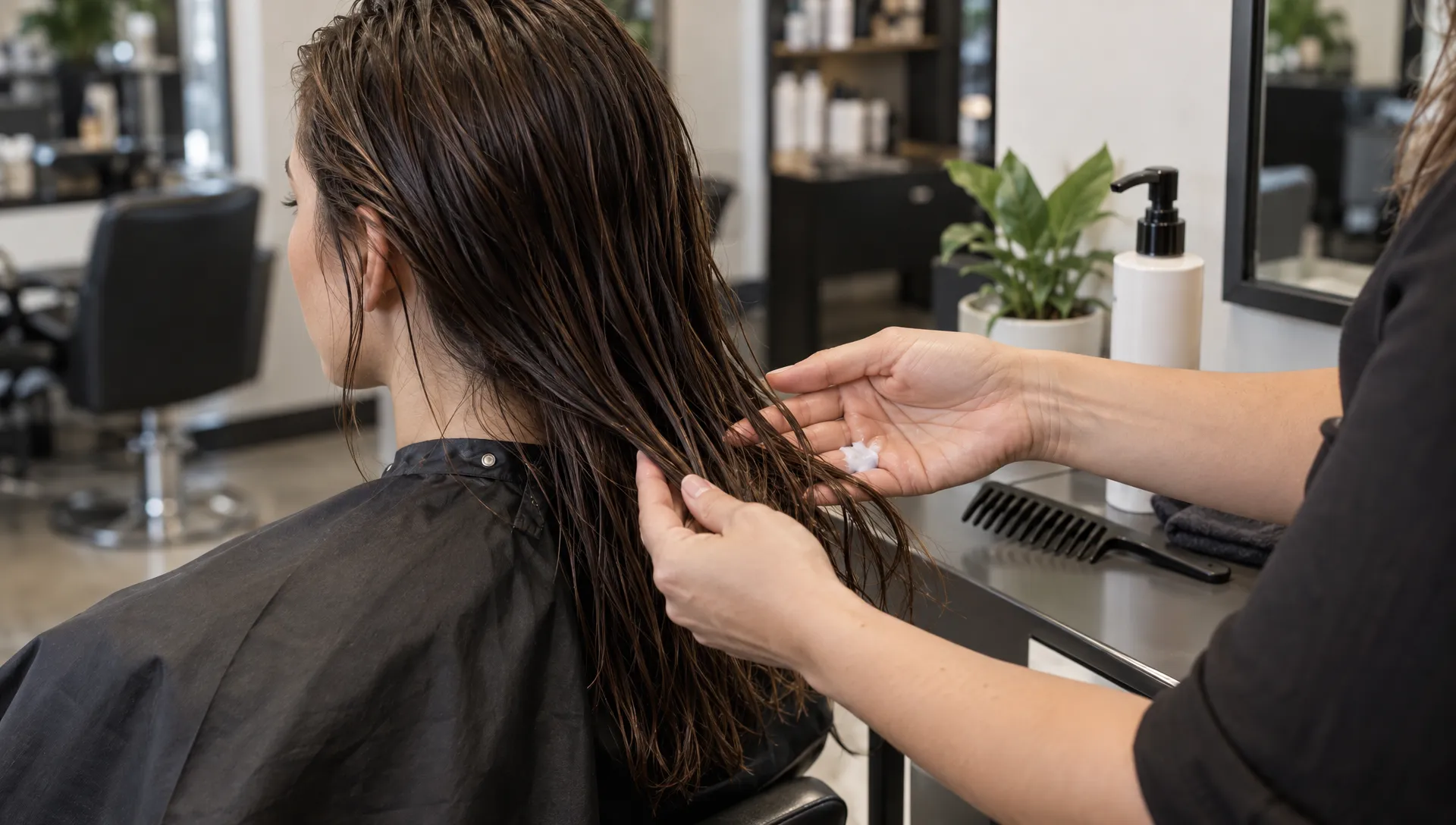
A stylist distributes a small amount of leave-in conditioner through damp hair ends beside a wide-tooth comb and pump bottle at a salon station.

How often should you use it?

Start on wash day rather than assuming you need a daily application. After your hair dries, check whether it feels comfortable and manageable through the next day or two.

How often you need a leave in hair treatment depends on how frequently you wash, the formula you use and whether your hair benefits from another application. A fine-haired client might need it only after shampooing, while someone with dry-feeling curls may benefit from a light refresh between washes if the product allows it.

Avoid repeatedly layering conditioner onto hair that already feels waxy, sticky or limp. Those signs can reflect too much product or a formula that does not suit your routine. Wash as needed and reassess.

The goal is consistent manageability, not a daily product quota. If rinse-out conditioner already gives you the result you want, skipping the leave-in is reasonable.

Adjust the routine for silk presses, extensions and protective styles

After a silk press

Do not automatically apply a water-based leave-in to a finished silk press. Moisture can cause straightened textured hair to revert, so the product and timing need to fit the style.

A leave in hair treatment may be useful during wash-day preparation, before drying and styling, but it should fit your stylist's plan. Confirm whether you also need a separate heat protectant and what, if anything, to apply afterward.

With extensions or protective styles

Follow the extension supplier's and installer's aftercare instructions. Some conditioning products need to stay away from attachment points, while heavy application can leave residue around braids or other protective styles.

Protective styling does not eliminate the need for cleansing or appropriate scalp care. Avoid saturating a style with conditioner to cover itching, tenderness or persistent buildup. Those symptoms call for reassessment, not another layer.

Your natural hair and any added hair may also have different care requirements. Ask where the product should go and how to remove it during cleansing.

When to ask for professional advice

If you have tried a smaller amount and a better-matched formula but still have significant roughness or breakage, bring your current products to a consultation. Describe when the problem began and mention recent chemical services, heat use and changes in your routine.

Our guide to when professional hair treatment is worth the investment can help you decide when home conditioning needs more support. Persistent scalp irritation or unexplained hair loss should be assessed by a dermatologist or another qualified medical professional.

Before a wedding or special event, test your leave in hair treatment well ahead of the final styling appointment. Your stylist needs to know whether it leaves residue or changes how your hair holds a style.

If event preparations also include dental care, keep that consultation separate from salon planning. A dental provider such as Nacka Strand Dental in Nacka Strand, Sweden addresses oral-health concerns, while your stylist focuses on hair condition and styling. Choose professional guidance for the specific concern rather than expecting a grooming product to do more than its intended job.

Frequently asked questions

Can I use leave-in conditioner instead of rinse-out conditioner? They serve different purposes. Rinse-out conditioner is the conditioning step after shampooing, while a leave-in adds ongoing manageability. Follow each product's directions rather than assuming one replaces the other.

Can I apply it to dry hair? Yes, if the label allows it. Start with a small amount on the areas that need help. Some formulas distribute better on damp hair and may leave dry hair feeling coated.

Should I use a leave in hair treatment every day? Not automatically. Use it when your hair benefits from it, and avoid adding more if your strands already feel soft or show signs of residue.

Will it fix split ends? No. It can temporarily improve how damaged ends feel or look, but split ends need trimming. Conditioning and gentler styling can help limit further damage.

Build a routine around your hair

At Kingdom Cute in Warner Robins, personalized consultations can help you connect your home routine with your haircut, color, silk press or protective style. Bring the names of the products you use and explain what happens between wash days.

Book an appointment with Kingdom Cute to discuss whether a leave-in belongs in your routine, which formula suits your needs and where a simpler approach may work better.

Saturday, October 3, 2026

Build a Pixie Haircut Gallery That Helps You Choose a Style

Build a Pixie Haircut Gallery That Helps You Choose a Style

A useful pixie haircut gallery does more than collect beautiful photos. It helps you identify the lengths, shapes and styling details you actually want, then explain those choices to your stylist. Without that structure, a folder of inspiration can leave you torn between cuts that have very little in common.

The goal is not to find one perfect picture to copy. It is to build a small, well-labeled collection that connects your preferences with your hair texture, daily routine and comfort level. Here is how to turn saved images into a clearer haircut decision.

Start With Your Nonnegotiables, Not More Photos

Before saving another image, write down what you need from your haircut. This gives you a filter for deciding which references belong in your collection.

Consider how much forehead and ear exposure feels comfortable, whether you want enough length to change your part and how much time you realistically spend styling. Include anything you want to avoid, such as a closely clipped neckline or fringe that falls into your eyes.

Keep preferences separate from assumptions. “I want softness around my ears” is useful information. “My face shape means I cannot have short hair” is a conclusion worth discussing rather than treating as a rule.

Choose three priorities you can explain in plain language. For example: a longer fringe, a neat neckline and a shape that works with your natural wave. Those priorities will help you recognize relevant photos, even when the model looks nothing like you.

Instead of saving everything to one folder, divide your references by the role they play in your decision. A phone album, Pinterest board or simple document can all work.

Overall Shapes

Save a few photos that show the general silhouette you like. Look for how much length sits on top, how closely the sides follow the head and whether the outline looks rounded, angular or softly grown out.

If you need a starting point, these pixie cut ideas to bring to a salon visit can help you put names to different shapes. Use the names to organize your references, not as a substitute for showing pictures.

Details You Want to Borrow

Some photos earn a place because of one feature: the fringe, sideburns, crown texture or neckline. Label that feature immediately so you do not later mistake the image for an endorsement of the whole haircut.

A note such as “love the soft edges, not the short top” gives your stylist more direction than a heart emoji.

Details You Do Not Want

A pixie haircut gallery becomes more useful when it includes a few clearly labeled dislikes. A photo showing too much scalp at the sides or a fringe that feels too heavy can clarify your boundaries.

Keep these examples limited and specific. Explain what you would change rather than simply marking the entire style “bad.”

Check What Each Photo Actually Shows

An attractive photograph does not necessarily provide enough information to plan a haircut. Before keeping it, check whether you can see the structure beneath the styling.

Compare Texture and Density Separately

Texture describes whether hair is straight, wavy, curly or coily. Density describes how much hair grows across the scalp. Fine individual strands can still be densely packed, so “fine” and “thin” are not interchangeable.

Look for references that resemble both your natural texture and your overall density. A heavily styled, straightened image may still be useful, but label it as a styled finish rather than an everyday expectation.

For curly or coily hair, note whether the reference shows the hair in its natural pattern, stretched or straightened. Length and silhouette can look very different across those states.

Find More Than One Angle

A front view helps you evaluate fringe and face framing. A side view shows the relationship between the top, temples and ears. A back view reveals the neckline and how the cut follows the head.

When reviewing your pixie haircut gallery, flag single-angle images as incomplete references. You can borrow a visible detail without assuming the hidden sections look a particular way.

Also notice head position. A tilted chin, tucked hair or a hand lifting the crown can change the apparent shape. Filters, extensions or wigs may be present without being disclosed, so treat a photograph as inspiration rather than proof of an achievable result.

Add Notes That Explain Your Choices

The most valuable part of a reference collection is often the sentence beneath each photo. Describe what caught your attention and what you would adapt.

Use concrete observations rather than vague labels such as “edgy” or “feminine.” Those words can mean different things to different people. “Short around the ears with a longer, side-swept fringe” is much easier to discuss.

What to record Useful example Why it helps
Main attraction Soft fringe that sits near the brows Identifies the feature you want to keep
Preferred adjustment More coverage around the ears Prevents an unwanted detail from being copied
Texture shown Waves styled with separation Distinguishes the cut from its finish
Missing information No clear back view Flags what still needs discussion
Everyday expectation Comfortable using a dryer, not a flat iron Connects the reference to your routine

Avoid requesting exact measurements from a photograph. Perspective and head size make those estimates unreliable. Point to where you want the hair to sit, then let your stylist translate that preference into an appropriate length.

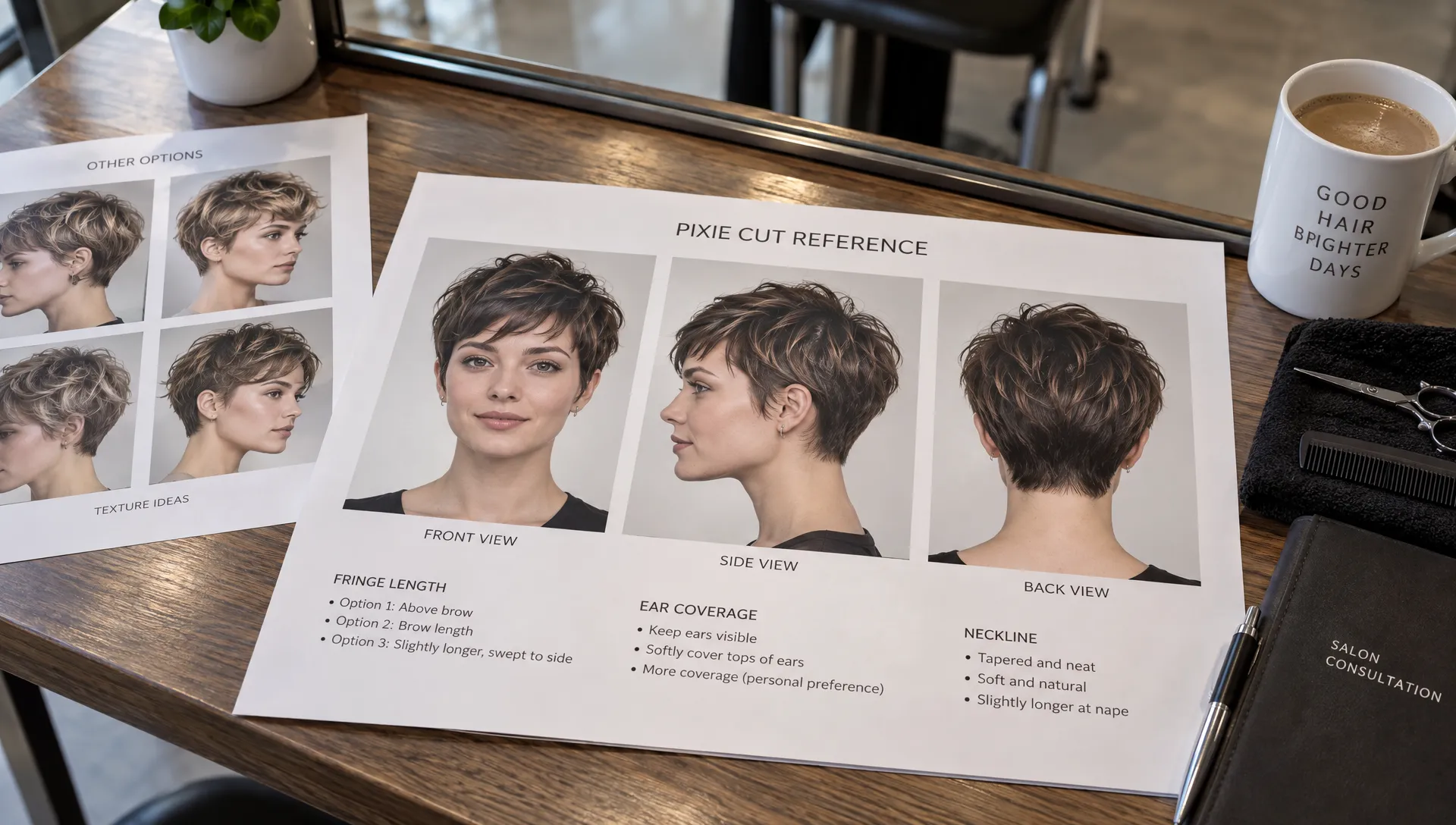
Printed pixie haircut references show front, side and back views alongside notes about fringe length, ear coverage and neckline preferences on a salon consultation table.

Give Each Favorite an Everyday Styling Check

A photo may show a fresh salon finish rather than what the haircut looks like after sleeping, exercising or letting it dry naturally. Ask what creates the result: the cut itself, heat styling, product, a particular part or some combination.

For every finalist in your pixie haircut gallery, write down the styling effort you are willing to make. Be honest about whether you will reshape the fringe each morning, use a diffuser or apply product to separate the top.

Your getting-ready setup matters too. A clear mirror and even lighting make it easier to check the sides and neckline. If you are refreshing that space, the furniture and lighting collections at Manor Editions can provide ideas for furnishing a dressing area. Keep decorative choices separate from the practical need to see your hair clearly while styling.

Discuss upkeep before committing. There is no universal trim schedule for every pixie: a tightly defined outline may need attention sooner than a softer, longer shape. Ask your stylist what changes you are likely to notice first and how the cut could look as it grows.

Reduce the Collection to a Small Shortlist

Once you have compared shape, texture and upkeep, choose a manageable set of finalists. Three overall looks plus a few detail references is a practical starting point, not a salon requirement.

Remove duplicates that communicate the same preference. Ten nearly identical fringe photos rarely add more clarity than two well-chosen examples.

A simple selection method is to assess each favorite against your original priorities:

  • Shape: Does it have the balance of top length, side coverage and neckline you want?
  • Hair match: Is the visible texture and density relevant, or does it need substantial adaptation?
  • Routine: Are you comfortable with the styling and maintenance it may involve?
  • Confidence: Do you like the haircut itself, or mainly the model's color, makeup and photography?

Your pixie haircut gallery does not need a single winner before the appointment. Two strong options with clear notes can support a better discussion than one photo you feel obligated to reproduce exactly.

Turn the Shortlist Into a Consultation Brief

Put your strongest overall reference first, followed by alternate views and detail images. Keep everything accessible on your phone or bring printed copies. Download key photos so a weak connection does not interrupt the conversation.

Prepare a short explanation: “I like this overall shape, this softer fringe and this amount of coverage around the ears. I do not want the closely clipped sides.” That statement gives the stylist both a direction and boundaries.

Then ask how your hairline, crown growth patterns, texture and density might change the result. A cowlick may affect where fringe sits, while natural curl can alter the apparent length. These are reasons to adapt a reference, not automatically reject it.

If you are still selecting a stylist, this guide to choosing the right salon for a pixie cut explains what to look for in short-hair experience and consultation quality.

Before cutting begins, confirm the planned fringe length, ear coverage and neckline together. Leave room for professional judgment, but make sure you understand any proposed departure from your references.

Frequently Asked Questions

How many photos should I bring? Bring enough to explain the overall shape and important details without overwhelming the discussion. Three main looks and a few labeled detail images are a useful starting point.

Can I use photos of people with different hair textures? Yes, but identify what you like and ask how it would translate. A silhouette may be adaptable even when the photographed finish would require a different styling routine.

Should every reference show the same hair color? No. Color can emphasize texture or change the apparent contrast with the scalp, so separate your haircut preferences from your color preferences when comparing images.

Can I combine features from different cuts? Sometimes. Fringe, crown length and side coverage need to work together, so your stylist should assess the combination rather than treat each detail as an independent instruction.

Bring Your References to Kingdom Cute

A thoughtfully edited pixie haircut gallery gives your consultation a clear starting point. You can show what appeals to you, explain your boundaries and discuss what will work with your own hair.

Kingdom Cute in Warner Robins, GA offers precision haircuts, styling and personalized consultations. Use Kingdom Cute's online appointment booking to plan your visit, then bring your shortlist and everyday styling expectations to the conversation.

Rent a Limo in Houston for Weddings, Events, and More

Rent a Limo in Houston for Weddings, Events, and More

Searching for “rent a limo houston” usually starts with an occasion: a wedding, a concert, an airport arrival or an evening worth celebrating. The best booking, however, starts with a clear schedule. Your vehicle needs to fit the passengers, luggage, pickup locations and time between stops, not just look impressive outside the venue.

This guide focuses on turning your plans into a workable transportation reservation. You’ll learn how to coordinate wedding pickups, choose between vehicle types, handle Houston airport arrivals and compare quotes without overlooking the details that affect your final bill.

Start With the Itinerary, Not the Vehicle Photo

Before requesting a quote, write down where your trip begins, where it ends and everything that happens between those points. A direct airport transfer and a wedding with hotel, ceremony and reception stops require different arrangements, even if the passenger count is identical.

In Houston, the distance between locations deserves particular attention. A hotel near the Galleria, a downtown ceremony and a reception outside the city center can create a substantial transportation window. Estimate travel time for the actual day and departure hour, then allow room for loading and venue access.

Give the transportation provider these details:

  • Your service date and required arrival time, not just your preferred pickup time
  • Every pickup, destination and planned intermediate stop
  • Passenger count, luggage quantity and any bulky items
  • Whether the vehicle should remain available between stops
  • The final departure time and contact information for the trip coordinator

When you rent a limo in Houston, distinguishing between a direct transfer and transportation held for multiple stops helps the provider quote the right service. It also reduces the chance of discovering that a vehicle is unavailable when your reception or event finishes.

Match the Vehicle to the People and the Occasion

A stretch limousine can be a good fit for a ceremonial arrival, but it is not automatically the best choice for every itinerary. Executive cars, SUVs and party buses serve different needs.

Grand Limousine offers these vehicle categories, along with professional chauffeurs and premium amenities. Confirm the specific vehicle available for your Houston date rather than assuming every fleet option is available locally at all times.

Vehicle category Useful for What to confirm before booking
Executive car Business travel, airport transfers and a couple’s private ride Passenger capacity and space for all luggage
SUV Small groups, airport trips and passengers carrying additional bags Usable luggage space with every passenger seated
Limousine Weddings, formal occasions and celebratory group arrivals Exact seating layout, entry access and storage space
Party bus Larger celebrations and group event transportation Approved passenger count, boarding arrangements and venue access

Passenger capacity and luggage capacity are separate questions. A vehicle that accommodates your group may not accommodate the same group’s suitcases, garment bags or event equipment.

If you plan to rent a limo in Houston for formalwear-heavy travel, ask about entry height and interior space. Wedding dresses, mobility needs and comfortable boarding matter more than selecting the longest vehicle in a photograph.

Wedding Transportation: Protect the Ceremony Timeline

Work backward from when everyone must be ready

The ceremony start time is rarely the right transportation deadline. Your wedding party may need to arrive earlier for photographs, dressing adjustments or instructions from the venue coordinator.

Start with that ready-by time and work backward through travel, boarding and any earlier pickups. Share the schedule with your photographer and planner so the transportation plan supports their work rather than competing with it.

For example, if a bridal party needs to be at the venue before guests arrive, its pickup should not depend on collecting relatives from several hotels first. Separate movements may be easier to manage than one vehicle making every stop.

Assign one person to communicate with the chauffeur. That person should know who is riding, where everyone is waiting and which changes require approval. The couple should not have to manage passenger calls during portraits.

Separate preparation, guest travel and the final exit

Keep fittings, salon appointments and other personal preparation outside the ceremony-day transportation window whenever possible. For a couple traveling from Brisbane to marry in Houston, that preparation might include arranging care with CP Dental in Brisbane before departure. Any dental appointments should be planned well ahead of the trip, not squeezed into the wedding schedule.

Guest transportation needs its own plan. Decide whether you are moving only the wedding party, providing selected family transfers or arranging transportation for a larger group. State those expectations clearly on guest communications.

When you rent a limo in Houston for a wedding, confirm the final exit separately from the earlier arrival. Specify where the couple will board, who will gather personal belongings and whether there are additional hotel drop-offs after the reception.

Concerts, Celebrations and Corporate Events Need a Return Plan

For a concert, gala or birthday dinner, the arrival is usually straightforward. The return trip deserves just as much planning, especially when crowds leave together or access roads become congested.

Ask the venue about permitted passenger loading locations. The closest entrance may not be a practical place for a limousine or party bus to wait. Agree on a meeting point your group can find without crossing restricted areas or searching through several parking lots.

Choose one group contact and establish what happens if someone wants to leave early. A shared vehicle cannot serve two destinations simultaneously, and an unplanned extra stop may change the service duration or price.

Corporate organizers should also consider whether guests need to arrive together or in separate waves. An executive car for a speaker and a larger vehicle for attendees can serve different schedules more effectively than forcing everyone onto one itinerary.

Before you rent a limo in Houston for an evening event, decide whether the chauffeur will remain available or return at a scheduled time. Do not assume waiting service is included in a pickup-and-drop-off quote.

Airport Transfers: Book for the Arrival Process, Not Just the Flight Time

Houston’s two main passenger airports are George Bush Intercontinental Airport (IAH) and William P. Hobby Airport (HOU). Include the airport code, airline and flight number when booking. “Houston airport” is not specific enough.

Grand Limousine offers airport transfers with flight tracking. That helps coordinate changing arrival times, but passengers still need time to leave the aircraft, collect baggage and, where applicable, clear immigration and customs.

Confirm how pickup timing works and when any waiting charges begin. Also ask whether your reservation uses a curbside meeting arrangement or another pickup method. Do not assume a terminal meet-and-greet is included unless your confirmation says so.

For current airport information, use Houston Airports’ official website alongside the instructions provided for your reservation. Pickup locations can depend on the airport, terminal and service arrangement.

If you rent a limo in Houston for arriving wedding guests or business visitors, give the provider a reachable passenger number. For departures, set the airport arrival target first, then work backward through the drive and boarding time. Flight tracking does not replace planning for road traffic.

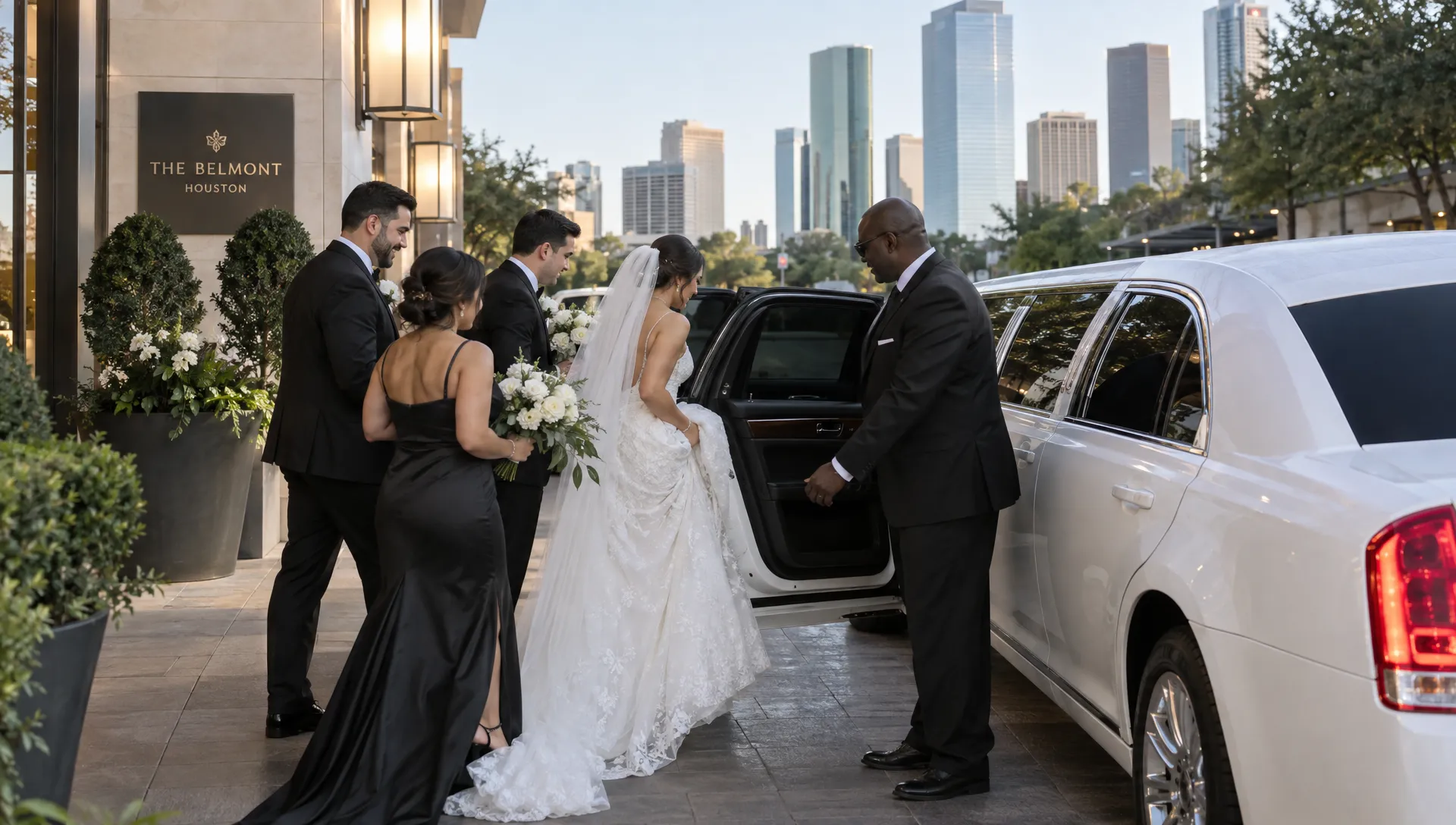
A wedding party boards a stretch limousine outside a Houston venue while the chauffeur holds the rear door open.

Your “rent a limo houston” Quote Checklist

A useful quote should connect the price to a defined service. Comparing headline hourly rates alone can hide differences in minimum booking periods, waiting arrangements or included stops.

Ask for the total quoted amount and its assumptions in writing. The confirmation should identify the vehicle category, scheduled service window, route and passenger count. It should also explain which changes could increase the bill.

Check these items before paying:

  • Minimum service duration and how additional time is billed
  • Treatment of tolls, parking, airport charges and gratuity
  • Included stops and charges for itinerary changes
  • Deposit requirements, payment timing and cancellation terms
  • Waiting allowances and procedures for delayed passengers
  • Any cleaning, damage or conduct provisions relevant to your event

For more context on the factors behind a quote, Grand Limousine’s guide to limousine costs in Houston can help you frame questions. Your own written quote should still govern the booking, since the date, vehicle and itinerary affect the price.

Transparent pricing is one of Grand Limousine’s stated features. Use that opportunity to resolve unclear charges before booking rather than making assumptions about what “all-inclusive” might mean.

Confirm the Details That Make the Ride Work

A few practical questions can prevent avoidable problems. If a passenger uses a mobility aid, describe the boarding and storage requirements before selecting a vehicle. Do not assume every limousine or SUV provides accessible entry.

For children, confirm appropriate restraint arrangements in advance. For celebrations, ask about beverage policies, decorations and any restrictions on food or items brought aboard. Premium amenities vary by vehicle, so request the features that matter to your group instead of assuming a particular setup.

When you rent a limo in Houston, keep the final itinerary accessible to both your organizer and the transportation provider. Review addresses, contact numbers and pickup instructions before the service date, then communicate changes promptly.

Grand Limousine provides 24/7 service and dispatch. Round-the-clock availability gives customers a contact point, but it does not guarantee that every vehicle category can accommodate a last-minute request.

Frequently Asked Questions

How far ahead should I book wedding transportation? Book once your date, venues and approximate passenger count are established. Earlier booking gives you more opportunity to secure a suitable vehicle. Confirm availability directly rather than relying on a fixed booking rule.

Can one limousine handle several wedding pickups? It may, provided the route and service window allow it. Multiple hotel stops can complicate arrival timing, so compare a shared route with separate transfers before deciding.

Is an SUV better than a limousine for an airport trip? It can be, particularly when luggage space and straightforward boarding are priorities. Choose based on the confirmed passenger and baggage capacity of the specific vehicle.

Can we add a stop during the ride? Ask the provider. An additional stop may affect the route, reserved time and price. Have the trip coordinator approve changes rather than letting several passengers give conflicting instructions.

Does 24/7 service mean I can book any vehicle immediately? No. Service and dispatch availability are different from vehicle availability. Your preferred category still needs to be confirmed for the date and itinerary.

Request a Ride Built Around Your Plans

To rent a limo in Houston with fewer booking uncertainties, start with your date, passenger count, destinations and required arrival times. Then confirm the vehicle, service window and complete price.

Use Grand Limousine’s instant booking and quote options to begin your reservation. For weddings, airport transfers or multi-stop events, share the full itinerary so the transportation arrangement matches the occasion.

Friday, October 2, 2026

How to Make a Curly Hair Blowout Last Without Losing Health

How to Make a Curly Hair Blowout Last Without Losing Health

A curly hair blowout should give you styling options without making your natural curls the price of a smooth finish. The healthiest way to extend it is to reduce friction, manage moisture exposure and avoid repeatedly heating hair that is already styled. Keeping every strand perfectly straight for as long as possible is not the goal.

For curly and coily hair, longevity also means knowing when to let the style go. A little root reversion is normal. An itchy scalp, increasing breakage or curls that stop returning after washing deserve more attention than another touch-up.

Start with your curls, not just the finished look

A blowout stretches naturally curly hair into a smoother, fuller shape using airflow, brushing and heat. It does not have to include flat ironing. If you want movement rather than pin-straight results, tell your stylist before the service begins.

Your starting condition matters more than a promised number of days. Bleached ends, recent chemical treatments, fragile edges and existing breakage can change how much heat or tension your hair tolerates. Share that history, including treatments done at home.

For a curly hair blowout, the consultation should also cover your normal wash schedule, exercise routine and how much humidity your hair encounters. Someone washing frequently for scalp comfort needs a different maintenance plan from someone styling for one special event.

If you are unsure which finish suits your texture, understanding how to choose a blowout for your hair type can help you describe your priorities. Ask for a result that works with your hair's condition, not one that requires daily correction.

Prepare clean, conditioned hair without overloading it

Product buildup makes it harder to judge how hair feels and can leave the finished style heavy. Start with an appropriate shampoo and rinse thoroughly. A clarifying wash may help when buildup is substantial, but it is not automatically necessary before every appointment.

Condition according to your hair's needs, then detangle gently while it has enough slip. Work from the ends upward rather than pulling through knots. Avoid rough towel drying; blot or squeeze out excess water instead.

Apply a heat protectant according to its directions. It can reduce heat-related damage, but it does not make high temperatures or repeated passes harmless. More product is not necessarily more protection, especially when several rich leave-ins are layered together.

The American Academy of Dermatology's guidance on preventing hair damage recommends lower heat settings and limiting hot-tool use. During drying, manageable sections, a moving dryer and controlled brush tension help avoid repeatedly working the same area.

A curly hair blowout should leave hair flexible, not stiff with product or uncomfortable at the roots. Report pulling, excessive heat or scalp discomfort immediately rather than assuming it is necessary for a lasting finish.

Help your curly hair blowout hold its shape overnight

Nighttime maintenance should preserve the shape without creating new tension. Let your hair and scalp cool completely before covering them, particularly if you are heading to bed soon after your appointment.

For a smooth finish, a loose wrap secured with snag-free clips may work well. For a rounded, bouncy finish, loosely placing dry lengths around large, soft rollers may preserve the bend better. Neither method should pull at your hairline or require tight fastening.

A satin or silk pillowcase, scarf or bonnet can reduce rubbing against rough bedding. Choose a comfortable fit and enough room for your hair. A tight bonnet band can put pressure on edges, while stuffing a voluminous style into a small bonnet can flatten it.

Ask your stylist to demonstrate the arrangement that matches your finish. A high ponytail or pineapple, useful for some natural curl routines, may leave a dent in stretched hair.

The best overnight routine for a curly hair blowout is one you can repeat gently. If securing it takes substantial pulling or dozens of pins, simplify the method rather than tightening it further.

Manage humidity without sacrificing scalp care

Moisture can cause stretched curls to return toward their natural shape. This happens because water affects temporary bonds involved in styling. Reversion from humidity does not, by itself, mean your hair is damaged.

In Warner Robins, humid weather can make completely unchanged roots an unrealistic expectation. A light anti-humidity finishing product may help, but no product makes hair waterproof. Use the amount recommended on the label and avoid repeatedly coating the lengths with oil.

During showers, keep hair covered with a well-fitting shower cap and reduce unnecessary steam exposure. After exercise, let your scalp cool before covering your hair. A dryer on a cool setting may help dry damp roots, but it cannot replace cleansing when your scalp needs it.

Protecting a curly hair blowout should not mean skipping workouts or tolerating sweat buildup for days. Choose a loose, low-tension way to keep hair off your neck and accept that some root texture may return.

If rain or heavy sweating leaves your hair wet, resist the urge to straighten it immediately. Hot irons belong on fully dry hair, and a style that needs a complete redo may be better replaced with a wash.

Refresh selectively instead of restyling everything

Before picking up a tool, identify what has actually changed. Flat roots, a bent end and widespread moisture reversion are different problems. They do not all need more heat.

Try the least disruptive option first:

  • Flat roots: Gently lift with your fingers or change your part rather than repeatedly teasing the same area.
  • A flattened bend: Use a large roller on dry hair if it can be secured without pulling or tangling.
  • Oily roots: Consider a small amount of dry shampoo, following its directions and avoiding an irritated scalp.
  • One misshapen section: If heat is appropriate for your hair, work only on that fully dry section at the lowest effective setting.

Dry shampoo absorbs oil; it does not remove sweat, dead skin or accumulated styling products. Stop adding it when your scalp feels coated or uncomfortable, and wash instead.

Refreshing a curly hair blowout should be occasional maintenance, not a daily second styling session. If you need to iron your roots every morning, choose a less demanding finish next time or shorten how long you wear it.

Avoid wetting the ends and then chasing the resulting reversion with heat. Likewise, heavy creams meant for your natural curl routine may not suit an already stretched style. Save them for wash day unless your stylist recommends otherwise.

A satin scarf and pillowcase sit beside an adult's loosely secured stretched hair, showing a gentle way to protect a curly hair blowout overnight.

Know the difference between reversion and warning signs

A few returning curls around the hairline are not a failure. They may simply reflect sweat, humidity or contact with water. Trying to eliminate every textured root can expose the most delicate areas to unnecessary heat and tension.

Other changes deserve a different response:

What you notice What it may mean A sensible next step
Roots become wavy after humidity or exercise Normal moisture-related reversion Accept some texture or change styles without reheating everything
Hair feels coated and the scalp is itchy Buildup or a scalp problem Cleanse rather than adding more styling product
Short pieces appear during gentle handling Possible breakage Reduce heat and tension, then ask your stylist to assess the hair
Some sections remain unusually limp after washing Possible heat damage or another change in hair condition Pause heat styling and arrange an assessment
Persistent burning, redness or sores A scalp problem needing attention Stop the irritating practice and seek medical advice

A curly hair blowout is not worth preserving through scalp pain or visible breakage. Persistent scalp symptoms belong with a dermatologist, while your stylist can help evaluate styling practices and vulnerable areas.

Conditioner can improve softness and manageability, but it cannot reliably restore a curl pattern that has been permanently altered by heat. Treat a consistent change after washing as a reason to reassess your routine, not to increase the temperature.

Let your scalp decide when the style ends

There is no universal number of days that makes a blowout healthy. Your scalp, product use, activity level and hair condition determine when washing makes sense. Some people need to cleanse sooner than others, and that does not mean their styling routine failed.

Wash when your scalp needs cleansing, rather than waiting for an arbitrary milestone. Noticeable buildup, persistent itching, odor or heavy oiliness are reasons to stop extending the style. If you have a diagnosed scalp condition, follow your clinician's care plan rather than changing it to protect a blowout.

A curly hair blowout should fit between appropriate wash days, not push them indefinitely farther apart. Scheduling it near an event can be more practical than trying to preserve it through a full week of workouts, outdoor plans and humid weather.

Reserve time for wash day during busy weeks

Put enough time for cleansing, conditioning and gentle detangling on your calendar before your week fills up. A rushed schedule can make another heat touch-up feel easier than the wash your scalp actually needs.

For business owners, protecting that time may also involve simplifying work routines. Those managing B2B sales can explore Prosperian's automated prospecting platform for lead sourcing and outreach tasks. Whatever your workload, keep personal-care time in the schedule rather than relying on repeated styling shortcuts.

Check your curls when you wash

When the style has run its course, cleanse thoroughly and condition as needed. Detangle gently, then observe your hair as it returns to its usual pattern. Compare similar conditions, such as wet hair after conditioning, rather than judging one dry strand against an old photograph.

Curls do not always look identical from wash to wash. Product residue, hair length and styling choices can affect their appearance. However, sections that remain consistently straighter or weaker than before deserve attention, especially after repeated heat exposure.

Between appointments, give yourself styling options that do not require a sleek finish. Wearing your curls, choosing a loose updo or using an appropriate low-tension style can reduce the temptation to restraighten.

The real measure of a successful curly hair blowout is not just how long it stays smooth. It is whether your scalp remains comfortable and your hair can return to a manageable natural routine afterward.

Frequently Asked Questions

How long should a blowout on curly hair last? There is no fixed healthy duration. Humidity, exercise, scalp oil and your usual cleansing needs all affect it. Aim for a few comfortable wear days if that suits your routine, but wash sooner when your scalp needs attention.

Can I flat iron my roots every day? Daily touch-ups add repeated heat exposure, particularly around delicate hairline areas. Try a different part, gentle wrapping or accepting some root texture instead. If the style requires daily ironing, discuss a more workable finish with your stylist.

Does a curly hair blowout permanently straighten curls? A blowout is intended to stretch curls temporarily. Excessive heat or repeated styling can damage hair and alter its pattern, so temporary styling is not a guarantee that every technique is harmless.

Should I add oil every night? Not automatically. Oil may add shine, but it does not cleanse the scalp or reverse heat damage. Repeated applications can weigh hair down. Use only what your hair needs and follow your stylist's product guidance.

What if my curls do not return after washing? Avoid immediately applying more heat. Cleanse and condition appropriately, then ask your stylist to assess persistent changes. Seek a dermatologist's advice if changes occur alongside scalp pain, inflammation or unexplained hair loss.

Plan a finish that respects your natural texture

Kingdom Cute offers personalized consultations, styling and scalp and conditioning treatments in Warner Robins. Bring your heat history, usual wash schedule and preferred finish to the conversation so your stylist can help you choose a practical approach.

Book your appointment with Kingdom Cute and ask how to maintain your style while keeping your natural curls and scalp care part of the plan.

How to Compare Orlando Limousine Companies for Events

How to Compare Orlando Limousine Companies for Events

Comparing Orlando limousine companies for an event starts with a practical question: which provider can carry out your exact itinerary without leaving important details unresolved? A polished vehicle photo and an attractive hourly rate cannot tell you whether the chauffeur will find the correct resort entrance, accommodate luggage or handle a reception that runs late.

The strongest comparison uses one shared trip brief, itemized quotes and written answers about local logistics. Here is how to separate an appealing offer from a dependable event transportation plan.

Build One Event Brief Before Requesting Quotes

Send every provider the same information. Otherwise, one company may quote a single transfer while another includes waiting time, multiple stops and a late-night return. Those prices are not comparable.

Your brief should identify the event date, passenger count, pickup addresses, required arrival times and final destination. Include luggage, mobility requirements and child-seat needs where applicable. For weddings, distinguish between the couple’s transportation, wedding-party travel and guest shuttles; they may require different vehicles and schedules.

Use a short list to capture details that commonly change the quote:

  • Service format: One-way transfer, hourly reservation or repeated shuttle trips.
  • Timing: Passenger-ready time, required arrival time and expected departure after the event.
  • Stops: Hotels, ceremony venue, photo locations, reception venue and return destinations.
  • Vehicle requirements: Seating, luggage space, boarding accessibility and requested amenities.
  • Coordination: One event-day contact who can approve changes and communicate with dispatch.

Ask providers to flag assumptions rather than silently fill in missing details. A quote based on “pickup in Orlando” is less useful than one based on a specific hotel entrance and destination.

When Orlando limousine companies quote the same passenger load, route and service window, differences in price and planning become much easier to assess. Keep that original brief attached to the final reservation so changes remain visible.

Compare Orlando Limousine Companies on Local Event Logistics

Orlando-area events can involve several distinct transportation zones. Downtown Orlando, Winter Park, International Drive and Lake Buena Vista should not be treated as interchangeable pickup locations. The route between them matters, particularly when the schedule includes multiple venues.

Ask each provider to explain its proposed pickup point, route allowance and arrival buffer. A useful answer references your actual itinerary rather than promising that traffic will not be a problem.

Check the Exact Venue Entrance

Large resorts and convention venues can have multiple entrances. At the Orange County Convention Center, specify the building and event entrance rather than relying on the venue name alone. For hotel events, confirm the designated loading area with the venue coordinator.

Ask where the vehicle will wait during the event and whether parking or staging charges apply. For theme park or resort celebrations, verify the current passenger drop-off arrangements rather than assuming the chauffeur can stop beside your chosen entrance.

Separate Airport Arrivals From Event Departures

Orlando International Airport (MCO) and Orlando Sanford International Airport (SFB) require different plans. Identify the airport, flight number, arrival date and onward destination for every arriving group.

For a mixed airport-and-event itinerary, Grand Limousine’s Orlando airport and event transportation guide provides additional planning context.

The better Orlando limousine companies will distinguish flight arrival from passenger-ready time and explain how baggage collection, meeting arrangements and waiting charges affect the reservation.

Make Safety and Fleet Verification a Booking Requirement

Before comparing luxury features, request the legal operating business name and confirmation of commercial insurance appropriate to the vehicle and service. Ask which permits or operating permissions apply to your pickup locations and how the provider verifies compliance.

If another operator will fulfill the reservation, find out who that operator is. Confirm which company handles dispatch, payment, service problems and any refund request. An affiliate arrangement is not automatically a problem, but responsibility should be clear before you pay.

Verify the Vehicle You Are Actually Booking

Request current photos of the proposed vehicle and written confirmation of its type, passenger capacity and luggage capacity. Ask whether the reservation guarantees that vehicle or a category, and what substitutions the contract permits.

A vehicle’s advertised seating capacity does not establish that your group will fit comfortably with suitcases, formal clothing or mobility equipment. For a wedding, consider boarding space and room for the dress. For corporate guests, consider whether everyone can travel together with their bags.

When comparing Orlando limousine companies, treat unresolved insurance questions, unclear operator identity and unsuitable vehicle capacity as reasons to pause the booking, not minor drawbacks to offset against a cheaper rate.

For celebrations involving a larger group, the party bus company comparison checklist covers additional questions about vehicle condition, onboard rules and reservation terms.

Compare the Total Price, Not the Hourly Headline

Request an itemized written quote based on the complete itinerary. A lower hourly rate can become a higher total once minimum hours, travel charges and waiting time are included.

The following comparison sheet helps expose differences without relying on assumed Orlando market rates:

Quote item What to confirm
Base service Vehicle category, included hours and minimum booking period
Billing clock Whether time starts at passenger pickup or includes vehicle travel to the pickup
Route expenses Treatment of tolls, parking and venue staging fees
Chauffeur-related charges Whether gratuity or a service charge is included, required or optional
Extra time Overtime rate, billing increment and authorization process
Reservation terms Deposit, payment deadline, cancellation and rescheduling conditions

Ask for two totals: the cost of the planned itinerary and the cost if service extends by one hour. This makes a likely event overrun easier to compare.

For shuttle work, clarify whether the quote covers a fixed service window, a set number of trips or another arrangement. These structures can produce different outcomes if guest boarding takes longer than expected.

Orlando limousine companies should also explain the distinction between a service charge and chauffeur gratuity rather than leaving you to infer it. Compare the final written amount and the conditions that could change it, not just the most prominent number on the quote.

An event planner reviews written limousine quotes and an itinerary listing hotel pickups, a wedding venue, and a reception beside a window overlooking parked vehicles.

Test What Happens When Plans Change

An event transportation plan should account for disruption before it happens. Give each shortlisted provider the same realistic scenario and compare the specificity of its response.

For a wedding, ask what happens if the reception ends 45 minutes late. For corporate transportation, ask how dispatch handles a delayed arriving flight when other passengers still need an on-time transfer. For a guest shuttle, ask what happens if more people need the final return trip than the vehicle can carry.

A useful response identifies who makes decisions, how the chauffeur receives updates and what additional service would cost. “We will take care of it” leaves too much undefined.

Also ask about a vehicle breakdown or chauffeur reassignment. You do not need a guarantee that nothing can go wrong; you need to understand the response process and its limitations.

The most informative difference between Orlando limousine companies may be their ability to explain these situations clearly before booking. Keep the answers in writing, especially any commitments about replacement vehicles, dispatch availability or changes to the service window.

Review recent customer feedback for comparable trips as well. An airport-transfer review provides less evidence about multi-stop wedding coordination than a review describing a similar event.

Score the Finalists Against Your Event Priorities

Once providers satisfy your safety, capacity and availability requirements, use a simple scorecard. The suggested weights below are a planning tool, not an industry rating system.

Comparison category Suggested weight Evidence to evaluate
Local itinerary planning 30% Exact entrances, route allowances and workable arrival buffers
Vehicle fit 25% Confirmed seating, luggage space and acceptable substitution terms
Total cost clarity 20% Itemized price and understandable extra-time charges
Contingency planning 15% Written process for delays, disruptions and schedule changes
Communication 10% Complete answers, clear documents and an identifiable contact

Score each category from zero to five. Multiply the score by the category weight divided by five. For example, a four-out-of-five logistics score earns 24 of the available 30 points.

Adjust the weights to match the event. A tightly scheduled ceremony may place greater emphasis on itinerary planning, while an executive transfer may prioritize vehicle suitability and clear coordination.

Scoring Orlando limousine companies this way helps prevent an impressive interior or a small price difference from outweighing the details that determine whether the event runs smoothly. Do not use the score to excuse a failed safety check or a vehicle that cannot accommodate your group.

Confirm the Final Schedule Before Paying a Deposit

Choose the provider whose written plan best matches your event, then reconcile the quote, itinerary and contract. Passenger counts, vehicle category, service hours and pickup addresses should agree across all three documents.

For destination weddings, keep pre-travel preparation separate from Orlando event logistics. A couple based in Australia might arrange dental care with Dentalspa in Geelong before flying, for example; the transportation brief should focus on local arrivals, venue transfers and photo stops. Personal preparation appointments should not leave the chauffeur working from an unfinished schedule.

Share the confirmed itinerary with the venue coordinator and your designated event-day contact. Guests should know their pickup location and passenger-ready time, not just the time the vehicle is expected to depart.

When choosing among Orlando limousine companies, verify that the final confirmation includes an event-day contact method and the procedure for authorizing extra time. Avoid having multiple guests independently request route changes.

If the contract differs from what a sales representative promised, resolve the discrepancy before payment. Keep a copy of the accepted terms and all subsequent changes together so your coordinator can reference them quickly.

Frequently Asked Questions

How far ahead should I compare providers for an Orlando event? Start once your date, venues and approximate passenger count are known. Large groups, multiple vehicles and tightly timed events benefit from earlier planning. Confirm actual availability rather than assuming a particular vehicle will remain open.

Is an hourly booking better than a point-to-point transfer? Hourly service can suit events with waiting time or several stops. A point-to-point transfer may suit a single journey. Ask providers to quote the structure that matches the itinerary and explain minimum charges.

What matters most when reading reviews of Orlando limousine companies? Look for recent reviews describing similar events, vehicles and coordination needs. Pay attention to pickup accuracy, communication and how problems were handled. A star average alone does not explain those details.

Does flight tracking eliminate airport waiting charges? Not necessarily. Flight tracking helps the provider monitor arrival changes, but waiting policies still depend on the reservation terms. Confirm when chargeable waiting starts, how baggage delays are handled and where passengers meet the chauffeur.

Request a Quote Built Around Your Event

Grand Limousine offers luxury vehicles, professional chauffeurs, airport transfers with flight tracking and 24/7 service and dispatch. For your Orlando event, request confirmation of the available vehicle, complete price and itinerary-specific arrangements.

Send your passenger count, venue addresses, timing requirements and planned stops when you request an event transportation quote from Grand Limousine. A detailed brief gives you a stronger basis for choosing the right service before committing to a reservation.