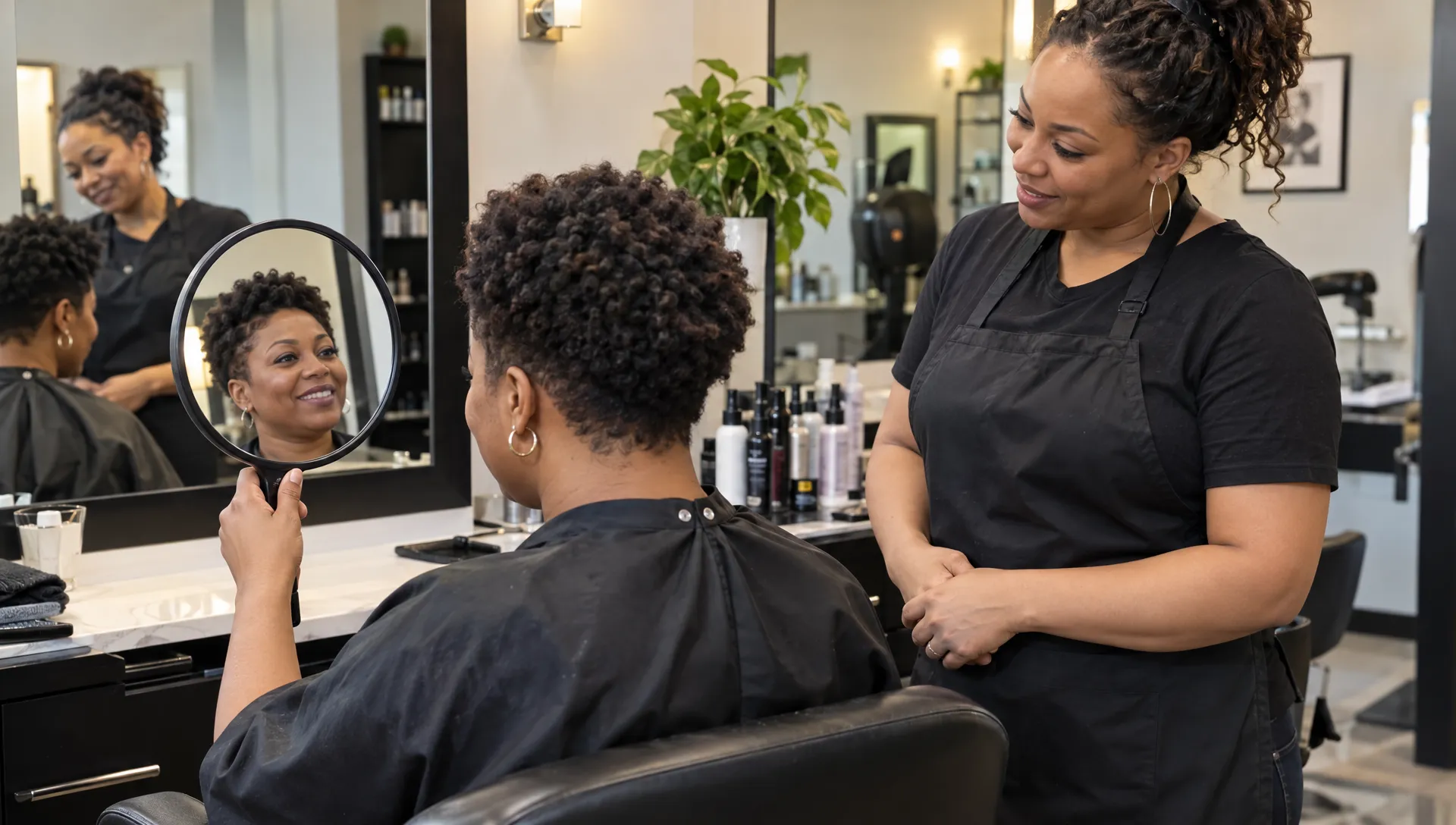
A blowout on short natural hair can reveal length hidden by shrinkage, soften the silhouette of a cut and make shaping easier. It cannot create extra inches, change your natural density or guarantee a glass-smooth finish without additional styling. The most satisfying result starts with choosing a look your current length and hair condition can support, rather than expecting a short, tightly coiled cut to behave like a shoulder-length silk press.
Start with stretch, not a longer haircut
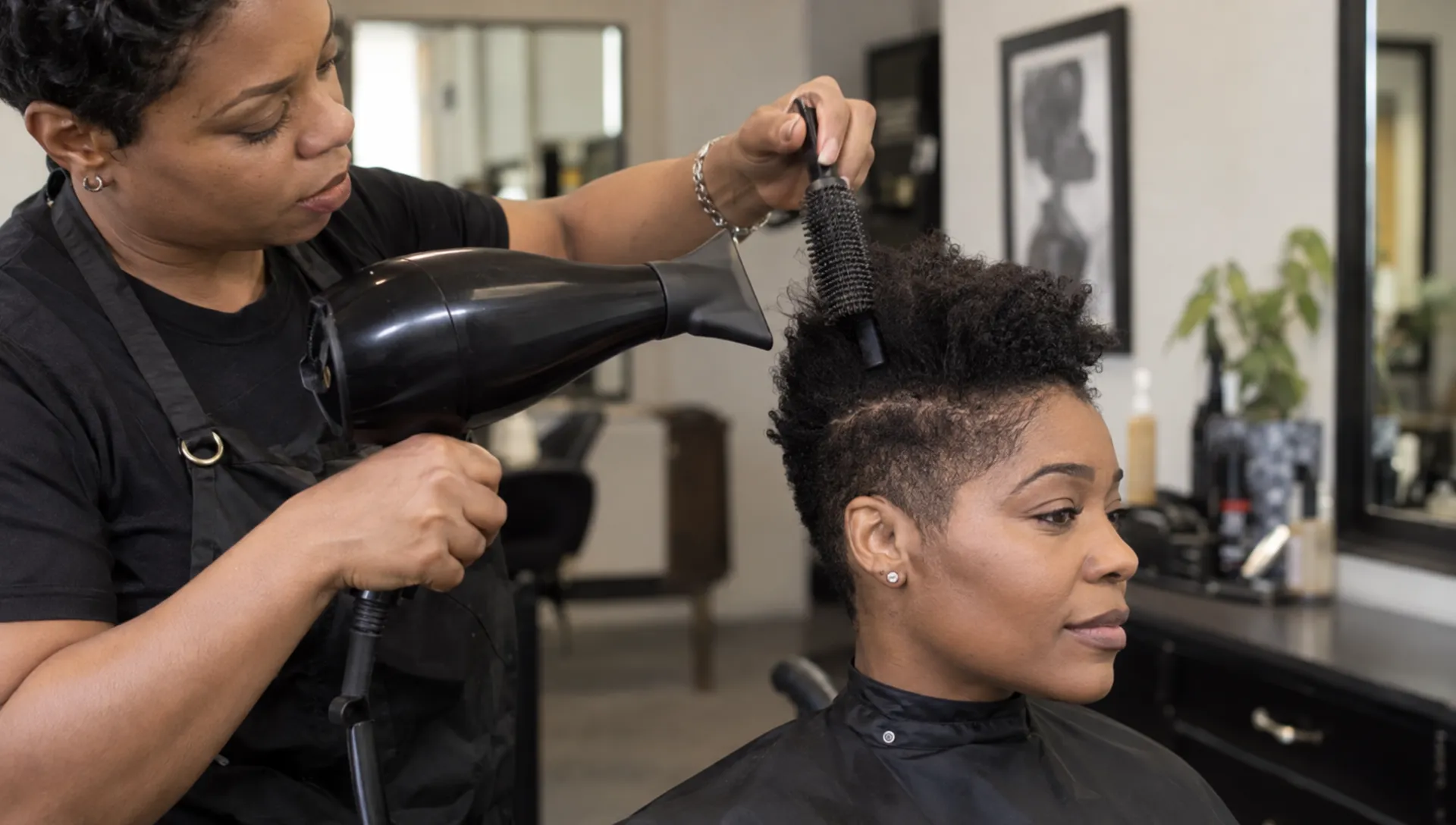
A traditional blowout uses a blow-dryer and controlled tension to temporarily stretch and shape the hair. On natural curls and coils, the change may be noticeable because the strands no longer sit as tightly contracted.
That is existing length becoming more visible, not new length. Hair that looks cropped when coiled may form a fuller rounded shape when stretched. A tapered cut may show more height through the top while staying close at the sides.
The finish can still have texture. Soft volume, movement and some remaining curl are all valid outcomes. Completely straight roots and highly polished ends are different goals that may call for another technique.
A standard blowout is also different from a Brazilian Blowout or other chemical smoothing service. A silk press generally adds flat-ironing after blow-drying. Ask what the appointment includes so you can make an informed choice about both the finish and the heat involved.
What a blowout on short natural hair can realistically look like
“Short” covers several very different starting points. The length available in each section matters more than a single label such as pixie or cropped cut.
| Starting shape | A realistic possibility | What may limit the result |
|---|---|---|
| Very close crop | A softer surface or modest directional shaping | There may not be enough length to engage a brush safely |
| Tapered cut with a longer top | More visible height, a lifted front or a rounded top | Short sides will not suddenly gain the movement of longer sections |
| Ear-length curls or coils | An expanded silhouette, a side sweep or softly turned ends | Layers and shrinkage affect where the finished outline sits |
| Short bob-length natural hair | More visible length, a smoother outline and some swing | Density, strand condition and the cut influence movement |
These are possibilities, not promises. One person's ear-length cut may have enough stretched length to tuck behind the ear, while another person's will not.
A good result should also look intentional from the side and back. If the haircut has uneven lengths, stretching can make those differences more visible rather than hide them.
Why similar lengths can produce different results
The outcome of a blowout on short natural hair depends on more than curl pattern. Two people with similar-looking coils can leave with very different amounts of volume and movement.
Density describes how much hair grows across the scalp; strand thickness describes the size of individual hairs. Dense hair may create a fuller silhouette, while lower-density hair may show more scalp around a strong part. Fine strands can become weighed down by products even when the overall head of hair is dense.
Shrinkage changes the before-and-after contrast, too. Greater shrinkage can make stretching look dramatic, but it does not tell you how healthy or heat-tolerant the hair is.
Condition matters just as much. Fragile ends, previous lightening or frequent heat use may make a gentler, less stretched finish the better choice. Stronger tension is not automatically the answer to hair that resists smoothing.
If you are comparing several finishes, understanding how to choose a blowout for your hair type can help you separate a volume goal from a straightness goal before your appointment.
Choose a reference photo for its shape, not just its shine
A useful reference for a blowout on short natural hair shows a comparable starting length and cut. A glossy photograph alone tells you little about whether the look required a flat iron, rollers, added hair or extensive finishing.
Look at where the volume sits. Is the top lifted while the sides stay compact? Do the ends curve under? Is the front long enough to sweep across the forehead? Those details give your stylist something concrete to assess.
Bring a photo of your own hair in a previous stretched style if you have one. It can be more useful than a stranger's finished look, especially when deciding how much length will be available around the face.
You can describe your goal this way: “I want the top stretched enough to sweep sideways, but I am comfortable keeping some texture. I do not want extra flat-ironing just to match the photo.”
Also identify what you do not want, such as a very expanded outline, flattened roots or ends turned tightly under. “Smooth” and “full” mean different things to different people.
Set a heat boundary before styling begins
A blowout on short natural hair is still heat styling. Short strands do not become damage-proof, and working close to the roots requires care around the scalp.
The American Academy of Dermatology's guidance on preventing hair damage recommends using the lowest heat setting and reducing how often heat tools are used. A heat protectant is a useful precaution, but it does not make unlimited heat or repeated passes safe.
Tell your stylist about recent coloring, breakage, scalp tenderness and how often you use heat at home. Ask whether your preferred finish is achievable with blow-drying alone. If extra smoothing would require flat-ironing, that should be a separate decision rather than an unexpected finishing step.
Comfort is a boundary, not a test of endurance. Speak up if the air feels painfully hot or the brush pulls at your scalp. More pulling should not be treated as the price of a smoother result.
When the hair cannot safely support the reference look, preserving some texture is a better outcome than repeatedly chasing the last bit of curl.
Expect a temporary style, not a weatherproof finish
There is no reliable wear-time promise for every head of hair. Humidity, sweat, washing, sleep habits and the amount of stretching all affect how quickly the shape changes.
A blowout on short natural hair may also evolve unevenly. The hairline can regain texture before the crown, while shorter sections may flatten overnight instead of holding the same curve as longer sections. Neither change automatically means the original styling was poorly done.
At night, a satin bonnet or scarf can reduce friction, but the fit matters. A tight wrap may flatten the height you wanted to preserve. Very short sides may need little manipulation, while a longer top may benefit from a loose arrangement your stylist demonstrates.
For more detailed maintenance, use these tips on making a blowout last longer without repeated heat styling. The goal is to preserve a wearable shape, not to force every section to remain identical to appointment day.
Agree on the finish before the dryer comes out
A consultation should establish a primary goal: visible length, root lift, a smoother outline or preparation for another style. Trying to maximize all four can lead to unnecessary styling and disappointment.
Ask your stylist to assess the shortest sections as well as the top. Those areas often determine whether a side sweep, rounded shape or tucked finish is realistic.
It is also worth discussing the haircut itself. A blowout can reveal an outline, but it cannot repair split ends or permanently correct an uneven cut. If reshaping would help, ask about that separately rather than assuming it is included.
Before leaving, have your stylist show you one simple way to reset the front or crown without adding heat. A finish you can comfortably wear and maintain is more useful than one that only looks right immediately after styling.
Frequently asked questions
How short is too short for a blowout? There is no universal minimum. A blowout on short natural hair requires enough length for the chosen tool and technique to work without excessive pulling. Very close-cropped sections may be better suited to gentle shaping than a brush-stretched finish.
Will my curls return after washing? A standard blowout is intended to be temporary, so the natural pattern should return when the hair is washed. Heat damage can prevent full reversion, however. Persistent straight sections, unusual breakage or a lasting texture change deserve assessment before more heat styling.
Can I refresh the style in two minutes? Sometimes. Adjusting the part, gently lifting flattened roots with your fingers or smoothing the front into a new direction may be enough. If the hair has substantially reverted, a two-minute refresh will not recreate the original finish without more involved styling.
Does a blowout make short hair healthier? No. It changes the appearance and arrangement of the strands. A polished finish is not proof of improved hair health, and heat styling does not repair damaged ends.
Plan a finish that works with your cut
The best blowout on short natural hair makes the most of the length you have without asking your strands to tolerate more than they should. A soft, shaped finish can be a successful result even when it is not completely straight.
At Kingdom Cute in Warner Robins, GA, discuss your reference photos, hair history and styling priorities during a personalized consultation. Use online appointment booking to plan a visit and choose a finish that suits your cut and everyday routine.

No comments:
Post a Comment