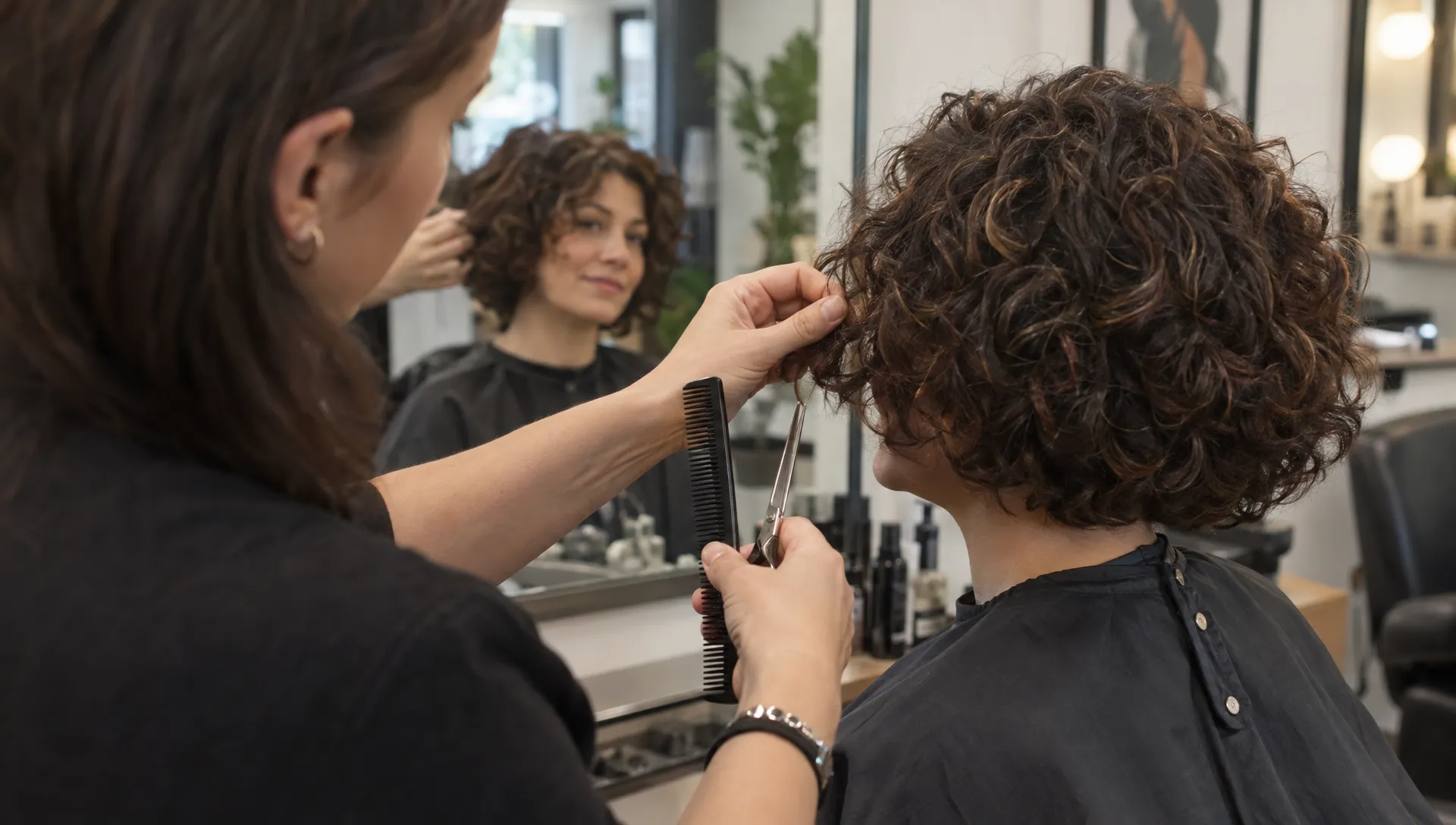
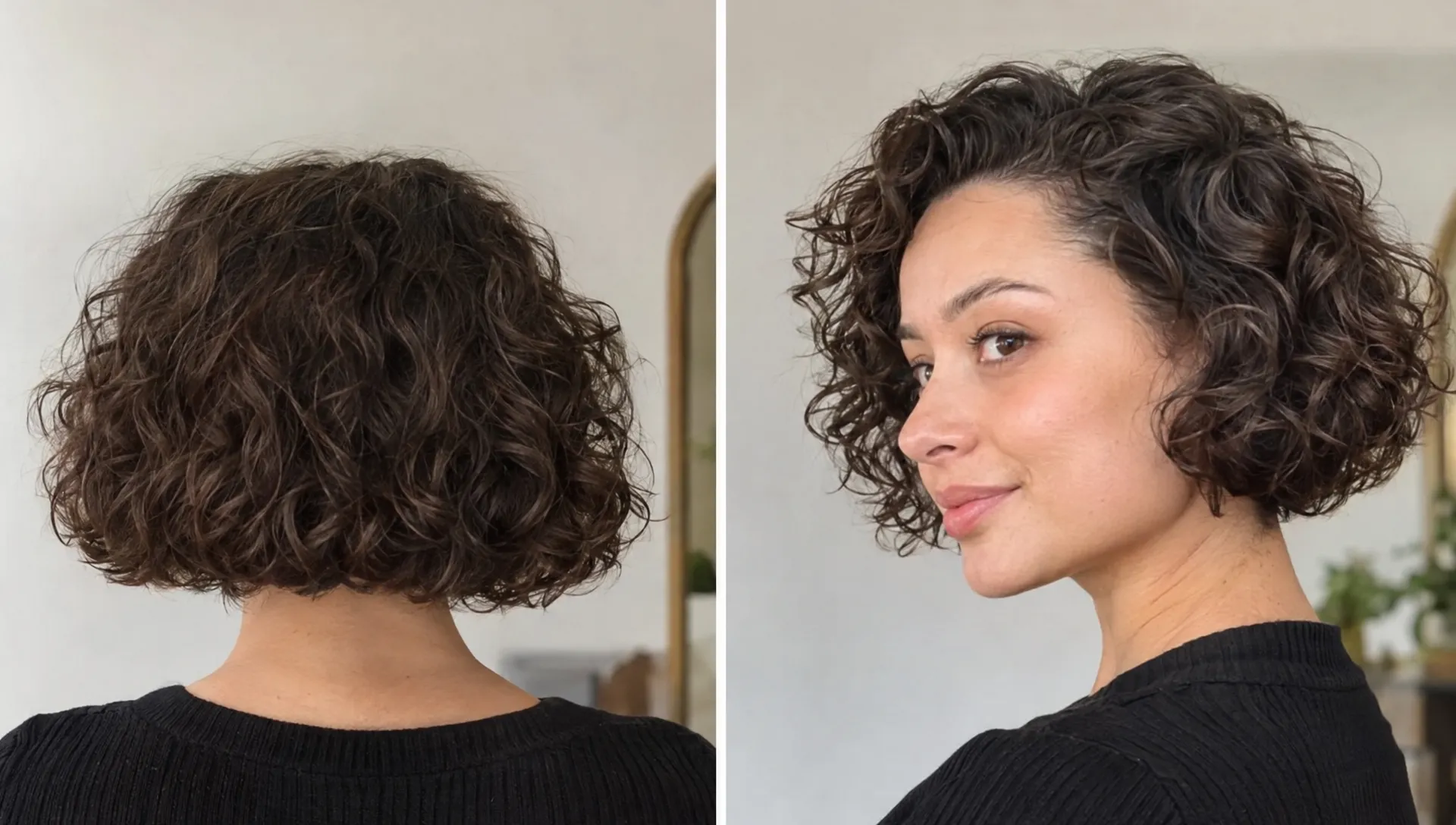
A short curly bob can look beautifully balanced on wash day, then settle into a shape that feels narrow at the crown and wide around the jaw. If that triangular outline is not what you wanted, the answer is not necessarily more layers or a shorter cut. It is usually a matter of where the hair holds weight, how your roots dry and how much your curls shrink.
The goal is to redistribute fullness without sacrificing the ends or creating a crown that takes extra work to style.
Why curls can form a triangular outline
A triangle develops when the lower half of the haircut projects farther outward than the upper half. Several things can contribute: a heavy perimeter, layers that have grown out, flattened roots or different curl patterns across the head.
Curly hair does not hang like straight hair. Individual curl groups bend, spring upward and sit against neighboring curls. When many of those groups finish at a similar level, fullness can collect around the bottom edge. Meanwhile, the weight of longer top sections may pull the crown flatter.
That does not make a full perimeter a bad choice. Some people love a strong, bottom-heavy silhouette. It only needs adjusting when it conflicts with the shape you want.
The useful question is whether the width comes from the haircut or the styling. If your short curly bob stays wide at the bottom through several different wash-day routines, the cut probably deserves attention. If the outline changes dramatically depending on drying technique or products, start there before removing more hair.
Identify the source before changing the cut
Look at your hair fully dry, with your usual part and without tucking it behind your ears. Check the front, profile and back. A front-facing photo alone can hide a heavy back section or a flat crown.
Use these observations as consultation clues, not as instructions for cutting your own hair:
| What you notice | Possible contributor | What to discuss or test |
|---|---|---|
| A dense shelf around the jaw or neck | Too much weight concentrated at the perimeter | Selective layering while preserving the outline |
| Flat roots with otherwise balanced ends | Root direction, product weight or drying habits | Lighter root application and supported drying |
| One side projects farther outward | Different curl patterns, density or styling direction | A dry balance check on both sides |
| A narrow crown and see-through ends | Too much hair already removed from the lengths | Preserving density rather than adding more layers |
Try comparing two normal wash days before deciding. Change one variable, such as keeping a rich cream away from the roots, rather than replacing every product at once. This makes it easier to tell what actually helped.
How to cut a short curly bob for better balance
Agree on the finished dry length
Show your stylist where you want the hair to sit when it is fully dry, not just where it reaches when stretched. The hair at your nape, temples and crown may shrink by different amounts.
Mention whether you usually air-dry, diffuse or stretch your curls. A shape designed around stretched styling may sit very differently when worn in its natural curl pattern.
Bring a reference photo for the outline, but explain what you like about it: cheekbone-level fullness, a rounded back or a defined jaw-length edge. Another person's curl size and density can make the same cut look quite different.
A balanced short curly bob starts with a realistic dry-length plan, especially when taking several inches off longer hair.
Move weight without emptying the ends
Layers can help distribute fullness above the perimeter, but “more layers” is not a precise solution. Their placement and length matter more than their number.
For dense hair, selected internal layers may reduce bulk while leaving a recognizable bob outline. For finer or lower-density curls, removing too much interior hair can leave gaps and wispy ends. Short crown layers can add lift, but they can also spring up more than expected.
Ask your stylist which sections need weight removed and which need weight preserved. Our guide to how layers bring shape to curly hair without losing definition explains that distinction in more detail.
There is no need to insist on or ban a particular tool. Ask what the proposed technique will do to your curl groups, perimeter and everyday styling instead.
Check the shape after the curls settle
Wet cutting and dry cutting can both have a place in shaping curls. What matters for this concern is seeing how the finished haircut behaves dry.
Before agreeing to additional shortening, ask to check the crown, sides and back in their settled state. A section that looks long while wet may bounce into place as it dries.
You can say: “I want my short curly bob to feel more rounded, without losing the fullness at the ends. Can we check where the weight collects before taking more length off?”
Style for root lift without expanding the sides
Keep product placement intentional
Use enough water and styling product to encourage curl grouping, but avoid assuming that more cream will create a better shape. Rich products can weigh down some roots, making the difference between a flat top and full ends more noticeable.
If your roots flatten easily, start with less conditioning or styling product near the scalp. Distribute your chosen hold product through the lengths so the ends stay grouped rather than separating into a wider halo.
For finer curls, a lighter foam or gel may be easier to work with than a heavy butter. Coarser or drier hair may need more conditioning. Let the result guide the amount: soft, supported curls are useful; coated roots and limp lengths suggest adjusting the application.
Dry the roots before repeatedly scrunching the ends
When diffusing, begin with gentle airflow around the roots and move around the head rather than repeatedly gathering the bottom sections into the diffuser bowl. Constantly pushing the ends upward can encourage more side volume than you intended.
Use a comfortable low or moderate heat setting and avoid holding heat in one place. A slight head tilt can help expose the roots without keeping your hair flipped upside down throughout drying.
For air-drying, small root clips may help support sections that collapse against the scalp. Place them without pulling tightly and remove them carefully once the hair is dry.
Styling can improve the balance of a short curly bob, but it cannot fully compensate for a perimeter that holds too much weight.
Finish without fluffing every section equally
Wait until your hair is fully dry before separating curls or softening a gel cast. Manipulating damp curls can disrupt their grouping and make the outline less predictable.
If you want more height, loosen the roots gently with your fingertips rather than raking through the entire length. Leave the sides mostly undisturbed if they already have enough fullness.
Check the back with a second mirror. It is easy to keep adding volume at the front while missing a flat crown or a dense lower-back section.
What to do if your bob already looks triangular
Start with the least permanent adjustment. Reset your curls with a normal wash, apply products deliberately and let the hair dry completely before judging the cut. Hair compressed by sleep, a hat or a tight tuck behind the ears may not show its usual shape.
If the imbalance remains, book a shape consultation rather than requesting an all-over trim. Cutting the same amount from every section may shorten the bob without changing where its fullness sits.
For an existing short curly bob, the most useful correction may be small: adjusting a few heavy sections, refining the face frame or preserving the perimeter while upper layers grow. It does not always require a dramatic restyle.
If the ends are already sparse, further thinning is unlikely to create the fuller, rounder result you want. Ask what can be improved now and what needs time to grow. Avoid cutting a curl at home simply because it sticks out on one wash day; its position can change with moisture, styling and shrinkage.
Keep the shape balanced as it grows
A bob can lose its balance before it looks noticeably longer. Upper layers may begin to weigh down the crown while the lower edge gathers more fullness.
Instead of choosing a maintenance interval based only on the calendar, watch for changes in styling effort. Needing much more root lifting, repeatedly pinning back the sides or losing the intended outline can signal that it is time for a shape review. Your stylist can recommend timing based on the cut and your growth pattern.
Take a few photos after a wash day you like. Those images give you and your stylist a useful reference for how the haircut behaves at home, not just immediately after a salon finish.
Keeping a short curly bob balanced is easier when maintenance follows its changing shape. For more on that process, see how a curly hair stylist creates a cut that grows out well.
Frequently asked questions
Does every curly bob need layers? No. Lower-density hair or looser curls may suit a stronger perimeter with minimal layering. Layers are useful when they solve a specific weight or shape issue, not simply because the hair is curly.
Can I keep a blunt edge without getting a triangle shape? Sometimes. A defined outer edge can coexist with selective shaping inside the haircut. Whether that works depends on your density, curl behavior and preferred amount of width around the jaw.
Will cutting the bob shorter fix the problem? Not automatically. Shortening can release more curl spring and increase width in some sections. The placement of weight needs to change if excess lower fullness is the underlying issue.
Can I fix the shape without heat styling? If flattened roots are the main problem, careful product placement and supported air-drying may help. If the silhouette comes from the cut, styling alone will have limits.
Plan your shape before your next trim
Bring photos of your hair on both a good wash day and a difficult one, then describe where you want more or less fullness. That gives your stylist a clearer starting point than asking for fewer layers or less bulk.
For a personalized haircut consultation in Warner Robins, GA, book an appointment with Kingdom Cute. Discuss your natural texture, daily routine and preferred silhouette before deciding how much hair to remove.

No comments:
Post a Comment