Monday, October 19, 2026

How to Evaluate Nashville Limo Companies for Your Event

How to Evaluate Nashville Limo Companies for Your Event

Searching for “the limo company of nashville” can bring up appealing vehicles, glowing reviews and promises of dependable service. For an event, though, the better question is which provider can document the right vehicle, a workable itinerary and clear terms for your date. A wedding departure, airport arrival or concert pickup leaves little room for confusion about who is driving, where everyone should meet or what the final bill includes.

Evaluate the operating plan, not just the vehicle photo. Use the same questions with every company so you can compare evidence rather than sales language.

Start With an Event Brief Every Company Can Quote

Before requesting prices, prepare one transportation brief and send it to each provider. Without consistent details, a lower quote may simply cover fewer hours, fewer stops or a smaller vehicle.

Include the information that affects both logistics and cost:

  • Date and service window: Provide the pickup time, required arrival time and expected finish, including any late-night return.
  • Passenger count: Give the actual number traveling together, including children who need appropriate restraints.
  • Locations and stops: List full addresses, venue entrances and any planned intermediate stops.
  • Luggage and special requirements: Mention suitcases, mobility equipment, formalwear or other items requiring space.
  • Service format: Specify whether you need one transfer, separate outbound and return trips or a vehicle retained throughout the event.

Separate firm requirements from preferences. Arriving before a ceremony starts is essential; a particular exterior color may be negotiable. The Nashville limo company you choose should explain how its proposal meets both, rather than letting a preferred vehicle distract from an unrealistic schedule.

How to Evaluate “the limo company of nashville” Search Results

Search visibility is not proof of reliability. Establish who will provide the transportation, what evidence supports their claims and how they handle problems before comparing decorative amenities.

Verify the Business and the Actual Carrier

Ask for the business’s legal name, a working contact number and documentation of commercial insurance appropriate to the proposed service. Confirm that the documentation is current and corresponds to the operator supplying your vehicle. A statement that a company is “fully insured” is not a substitute for evidence.

Also ask whether the ride will be operated directly or assigned to another transportation company. Subcontracting is not automatically a problem, but you should know who supplies the vehicle, who dispatches the chauffeur and who handles a service failure.

For interstate service, ask about applicable federal operating requirements. The FMCSA Company Snapshot can help you check a carrier’s federal record where applicable. It is not a universal verification tool for every local limousine trip, so ask which state or local requirements apply as well.

Read Reviews for Operational Patterns

When reviewing results for “the limo company of nashville,” prioritize descriptions of completed trips over broad praise. Look for details about punctuality, vehicle condition, communication and accurate billing.

Read across recent reviews rather than relying on one excellent or terrible experience. Repeated complaints about last-minute vehicle changes deserve closer questioning. So do consistent reports of unanswered calls during service.

Ask how the company would manage your specific complication, such as a reception running late. A concrete explanation of dispatch procedures is more useful than another assurance that everything will be fine.

Confirm That the Actual Vehicle Fits Your Group

A vehicle’s advertised passenger capacity does not tell you everything about usable space. Ask for the proposed vehicle type, seating configuration and luggage capacity for your exact group.

For example, an airport group with large suitcases has different requirements from wedding guests carrying small bags. A stretched vehicle may accommodate passengers but offer limited luggage room. A party bus’s seating layout also matters for guests wearing formal clothing or needing easier entry.

Request current photographs of the vehicle proposed for your booking, not just representative fleet images. If a specific vehicle cannot be guaranteed, ask what is guaranteed and how substitutions are approved.

The limo company in Nashville that best fits your event should also explain which amenities are included and available on that vehicle. Confirm climate control, charging options, refreshments or entertainment features that matter to your group rather than assuming every fleet vehicle has them.

For a celebration itinerary, our Nashville limousine planning guide provides additional context for matching transportation to your stops and schedule.

Compare the Complete Cost, Not the Advertised Rate

There is no useful single price for every Nashville limo booking. The total depends on the date, vehicle, duration, itinerary and service terms. Request an itemized written quote based on your event brief rather than treating an advertised starting rate as your budget.

Ask whether the quoted amount includes the minimum booking period, travel to and from the operating base, applicable taxes, mandatory fees and chauffeur gratuity. If a service charge appears, confirm whether any of it is gratuity. The terms should distinguish the two.

Overtime deserves particular attention. Find out when it begins, how it is billed and whether an extension is subject to availability. A chauffeur may have another assignment after your reservation, so paying extra does not necessarily mean the vehicle can remain.

A quote found through “the limo company of nashville” should be treated as provisional until the provider confirms the full itinerary and inclusions in writing. Compare the final total for equivalent service, not one provider’s base hourly rate against another’s complete package.

For group budgeting, divide the complete transportation cost by the number of paying passengers. Compare that figure with the cost of transporting the same group, in both directions, using enough alternative vehicles.

An event organizer checks quotes and a passenger list near parked vehicles while comparing the limo company of Nashville for an event.

Test the Nashville Pickup and Dispatch Plan

A provider should be able to turn your addresses into practical meeting instructions. For a busy downtown venue, “we will pick you up outside” may not be precise enough. Ask for the intended entrance, a legal stopping location and an alternative meeting point if access changes.

The schedule should account for venue access, guest loading and traffic variability, not merely the driving time shown on a map. For weddings, discuss separate arrival deadlines for the couple and guests. For corporate events, establish who can approve itinerary changes.

The Nashville limo company handling your booking should identify the event-day contact and explain how you will receive chauffeur or dispatch details. Ask who answers if your group cannot locate the vehicle after midnight.

For Nashville International Airport transfers, confirm flight details, baggage needs, meeting instructions and how waiting time is charged. Flight tracking helps with schedule changes, but it does not resolve every delay after landing. Consult BNA’s ground transportation information for airport guidance and confirm the applicable pickup arrangement with your provider.

Read the Contract for Changes and Service Failures

A friendly conversation is not enough when deposits and event deadlines are involved. Before paying, check that the agreement identifies the service date, vehicle category, passenger count, itinerary, reservation period and total charges.

Review the cancellation and rescheduling deadlines carefully. Ask whether changing the event date requires a new quote and what happens if weather or a venue closure disrupts your plans. Do not assume a deposit is refundable or transferable.

The agreement should also address vehicle substitution and provider cancellation. Ask what happens if the assigned vehicle becomes unavailable, how an alternative is selected and what remedy applies if the company cannot deliver the agreed service.

Clarify responsibility for cleaning or damage charges and who may authorize additional stops or time. For weddings and corporate bookings, appoint one decision-maker so the chauffeur does not receive conflicting instructions from several passengers.

Use an Evidence-Based Comparison Before Paying

A shortlist built from “the limo company of nashville” search results becomes more useful when every provider is assessed against the same requirements. Record answers in a simple comparison sheet and mark unanswered questions as unresolved, not assumed approvals.

Evaluation area Evidence to request Reason to pause
Operator identity Legal business name and actual service provider Unclear responsibility for the ride
Insurance Current commercial coverage documentation Refusal to provide supporting information
Vehicle suitability Seating details, luggage fit and current photos Capacity promises without specifics
Total price Itemized quote and overtime terms Unexplained fees or inconsistent totals
Event-day support Dispatch contact and pickup instructions No clear contact during your service window
Contract protection Written cancellation and substitution terms Pressure to pay before receiving terms

Resolve safety, capacity and accountability questions before weighing luxury extras. A lower price does not compensate for a vehicle that cannot carry your luggage or a company that will not identify who operates the trip.

Once those essentials are satisfied, compare comfort, presentation and cost. That order keeps the decision focused on whether the service will work for your event.

Frequently Asked Questions

What Nashville limo company is most reliable? Reliability should be supported by recent reviews describing completed trips, clear operating details, current insurance documentation and a practical dispatch plan. No single review score or search position establishes which provider will be most dependable for your booking.

How much does a limo cost in Nashville? Request a written quote for your date, passenger count, vehicle and itinerary. Compare minimum hours, mandatory charges, gratuity terms and overtime rules. Without those details, an hourly figure does not show what your event transportation will actually cost.

Is a limo cheaper than Uber? It depends on group size, timing and service requirements. Compare the full limo quote with enough rideshare vehicles for the entire group and every planned journey. For a small, simple trip, rideshare may cost less; coordinated group transportation may justify a different budget.

How early should I book event transportation? Contact providers once your date, approximate headcount and venue are confirmed. Availability varies, particularly when you need a specific vehicle. Choose the Nashville limo company that can confirm suitable service and clear terms, rather than paying quickly because of an unsupported urgency claim.

Request a Quote You Can Compare

Grand Limousine offers limousines, party buses, executive cars and SUVs, with professional chauffeurs, 24/7 service and dispatch, and airport transfers with flight tracking. To assess the fit for your Nashville event, send your date, passenger count, stops and timing through Grand Limousine.

Request confirmation of vehicle availability, complete pricing and booking terms for your itinerary. A clear proposal gives you the information needed to make a confident comparison before committing.


Sunday, October 18, 2026

When Blue Shampoo Helps Brunettes and When to Skip It

When Blue Shampoo Helps Brunettes and When to Skip It

Brunette hair can turn warmer between salon visits, but blue shampoo is only helpful when that warmth is orange. It deposits cool pigment to soften an unwanted coppery cast. It does not lighten brown hair, fix every kind of brassiness or replace a color correction.

Before adding another bottle to your shower, look at your hair in indirect daylight. Orange mids, yellow highlights and an intentionally warm chestnut shade need different treatment. The right choice starts with identifying what you actually want to change.

Match the product to the warmth you see

Toning shampoos work through complementary colors: blue counteracts orange, while violet counteracts yellow. That distinction matters more than whether a bottle says “for brunettes” or “for blondes.”

Use this as a starting point, not a substitute for assessing your hair’s condition:

What you see What may help What to watch for
Unwanted orange in lightened brown hair A blue-pigmented toning formula Pale highlights may pick up too much pigment
Yellow in blonde highlights A violet-pigmented formula Brown sections may not need toning
A mix of yellow and orange A stylist-selected toning approach One formula may not suit every section
Red warmth in dark brown hair A professional color assessment Blue alone may not address the dominant tone

When blue shampoo helps brunettes

The clearest use case is brown hair that has been lightened and now looks more orange than intended. This can happen with an all-over lighter brunette shade, balayage or caramel highlights as the salon toner fades and underlying warmth becomes more noticeable.

Imagine a cool medium-brown result that gradually develops coppery mids and ends. A suitable toning wash may make those sections look more neutral without another lightening service. The result is a temporary visual adjustment, not the removal of the warm pigment underneath.

It works best as maintenance for a color you already like. If the depth, placement and overall shade are right, but orange warmth is creeping back, a pigment-depositing shampoo may help stretch the time between toning appointments.

Untreated brown hair can sometimes show a subtle cooling effect, too. However, very dark hair may show little visible change because its depth masks the deposited pigment. Using more product or leaving it on longer will not turn dark brown hair into a lighter, ash-brown shade.

When to skip it and choose something else

Blue shampoo is the wrong match when the unwanted tone is mainly yellow, when warmth is part of your intended color or when the problem involves uneven lightening rather than simple fading. Adding cool pigment indiscriminately can make an otherwise flattering shade look flat.

Your highlights are yellow rather than orange

Pale blonde ribbons usually call for violet rather than blue. Depositing blue onto yellow hair can create a greenish cast, especially on light, porous sections that absorb pigment readily.

Mixed-color hair needs particular care. Your brown base may look orange while your lightest highlights look yellow. Applying the same product everywhere can improve one area and muddy another. Ask your colorist whether targeted application or a different formula makes more sense.

You chose a warm brunette shade

Copper, cinnamon, golden brown and warm chestnut are not automatically “brassy.” Those tones may be exactly what makes the color flattering.

Before neutralizing them, compare your current hair with a photo of your fresh salon result in similar lighting. If the warmth was there from the start and you liked it, cooling the whole head may work against your original goal.

Your hair is fragile, patchy or your scalp is irritated

Blue shampoo cannot repair breakage, equalize uneven bleaching or solve scalp irritation. If your hair has very light, rough ends alongside healthier darker sections, the ends may grab substantially more pigment and look smoky, blue-green or dull.

Porosity describes how readily hair takes up and releases moisture and other substances. Chemical processing and weathering can make that behavior uneven along a strand, so the same wash can produce different results from roots to ends.

If your hair feels gummy when wet, snaps easily or has sharply defined bands of different color, pause toning experiments and arrange a professional assessment. Those concerns need a plan beyond adjusting warmth.

An uncomfortable scalp is another reason to stop. Rinse out any product that causes burning or irritation and discontinue it. Persistent symptoms deserve medical advice, not another color-maintenance product.

Also check with your stylist before introducing a new toning wash immediately after a color service. Your freshly finished shade may not need additional pigment yet.

How to use it without over-toning

There is no universal processing time for blue shampoo. Pigment strength, cleansing ingredients and application directions vary, so follow the instructions on your specific bottle rather than a social-media timer.

Choosing a formula also means considering dryness, scalp needs and chemical history. Our guide to selecting products that suit your hair’s condition explains why the strongest-looking product is not necessarily the best fit.

  1. Check the directions first: Confirm whether the formula goes on wet or dry hair, its recommended contact time and any precautions. Do not assume it works like a previous brand.
  2. Test a discreet strand: Choose a small hidden section that represents the hair you want to tone. Include a lightened end if those ends will receive the product.
  3. Start conservatively: For the test, use the shortest contact time within the label’s directions. Rinse and assess the strand dry before treating a larger area.
  4. Apply evenly where appropriate: Work through the intended sections without automatically saturating pale highlights or fragile ends. Wear gloves if the label recommends them.
  5. Rinse and condition: Remove the shampoo thoroughly, then use a conditioner suited to your hair. Judge the result once dry in consistent lighting.

Do not leave it on overnight or apply heat unless the manufacturer specifically directs it. Longer exposure can mean more pigment deposit, not a better match to your target shade.

A close overhead view of three brunette hair swatches on a salon colorist's work surface: one copper-orange, one cooler brown after blue shampoo, and one pale highlighted swatch with a greenish cast.

Adjust the routine to your hair, not a fixed calendar

Frequency should follow the product directions and how your color responds. Treat toning as an occasional maintenance step rather than automatically replacing every regular wash. If your hair already looks balanced, adding more pigment offers little benefit.

After a successful test, assess the result before the next use. You may need less frequent toning than the bottle’s maximum suggested schedule, particularly if you wash infrequently or have very light ends. Keep your usual cleansing and conditioning routine between toning sessions.

For curls and coils, the target undertone is still what determines the pigment choice. Texture does not change the color wheel, but a drying or poorly matched cleansing formula can make detangling and moisture management harder. Choose the whole formula, not just its color.

Extensions need separate consideration. Follow the extension supplier’s care instructions and your stylist’s guidance before using pigment-depositing products. Extension hair and your natural hair may take up color differently, even when they initially look like the same shade.

If the result becomes dull or develops a blue or green cast, stop depositing pigment. Avoid immediately reaching for bleach, harsh household mixtures or repeated aggressive washing to strip it out.

Know when a salon toner is the better option

Blue shampoo can maintain a suitable shade, but a salon toner offers more control over the color formula and where it is applied. That distinction matters when your roots, mids and ends need different adjustments.

Book a consultation if the orange is intense, returns quickly despite careful use or appears alongside bands of uneven color. The issue may involve the original lightening level, fading artificial color or sections with different processing histories. A shampoo cannot correct all of those variables.

Bring photos of your preferred result, a picture of your freshly colored hair if available and the names of products you have used. Tell your stylist about previous lightening, box dye, relaxers and other chemical services so they can assess what is realistic.

You can also ask for a lower-maintenance color plan that works with your natural depth and preferred warmth. A slightly warmer or deeper brunette may suit your routine better than repeatedly trying to maintain a very cool finish.

Frequently asked questions

Does blue shampoo lighten brown hair? No. It deposits pigment to reduce the appearance of orange warmth; it does not lift your natural color or lighten existing dye. A cooler-looking result may seem different in brightness, but that is not the same as making the hair lighter.

Can I mix blue and purple formulas? Mixing them is not a reliable shortcut to a custom toner. Pigment concentrations and product directions vary, making the result hard to predict. If your hair has both orange and yellow areas, ask your stylist about a suitable combined formula or separate treatment of different sections.

What does purple shampoo do to brown hair? It may soften yellow tones in lighter pieces within brown hair. It generally will not neutralize clearly orange sections effectively because violet targets yellow rather than orange. On very dark brown hair, any visible change may be minimal.

Will one wash remove all the brassiness? Not necessarily. The outcome depends on the starting tone, pigment concentration, contact time and hair condition. Assess the dry result after following the label instead of repeatedly washing until the warmth disappears. Some starting shades require professional toning or correction.

Is a toning wash also a deep-conditioning treatment? Not automatically. Some formulas include conditioning ingredients, but pigment deposit and conditioning are different jobs. Keep a suitable conditioner in your routine and address persistent roughness or breakage separately rather than expecting a color-maintenance wash to repair it.

Get a maintenance plan for your brunette shade

The best reason to use blue shampoo is specific: you like your brunette color, but unwanted orange is showing through. If you are unsure whether you are seeing orange, yellow or intentional warmth, get that distinction settled before experimenting.

At Kingdom Cute in Warner Robins, GA, a personalized color consultation can help you discuss your current shade, hair history and maintenance goals. Book an appointment to work out whether at-home toning or a salon color service is the more appropriate next step.

How to Compare Limo Companies Before You Reserve

How to Compare Limo Companies Before You Reserve

Searching for limo companies near me gives you options, but it does not tell you which reservation will hold up when a flight lands late or an event runs long. Before paying a deposit, compare what each provider will commit to in writing, not just vehicle photos or an attractive hourly rate.

A useful comparison has three layers: a suitable vehicle, a clearly defined total and a workable plan for changes. The goal is to identify the company whose booking terms fit your actual trip, then confirm those terms before money changes hands.

Give every company the same reservation brief

Two quotes cannot be compared fairly if one includes multiple stops and the other assumes a direct transfer. Send each provider the same itinerary, including pickup locations, dates, passenger count, luggage and the time everyone needs to arrive.

Describe the service pattern, too. A driver dropping you at dinner is different from a vehicle remaining available throughout the evening. For weddings, distinguish ceremony transportation from the final reception departure.

A useful request might read:

We need transportation for six adults with six checked bags from the airport to our hotel. Please quote the appropriate vehicle, explain when waiting charges begin and confirm whether parking, tolls and gratuity are included.

Include accessibility requirements, child-seat needs or unusual cargo before requesting a price. Ask the provider to confirm suitability rather than assuming that a vehicle advertised for six passengers can also accommodate six large suitcases.

Screen “limo companies near me” for booking readiness

Before comparing extras, establish who will operate the trip. The name on a website, the company accepting payment and the actual transportation operator may not be identical, particularly when an affiliate handles service in another city.

Ask for the operator’s legal business name and evidence of appropriate commercial passenger transportation insurance. Confirm that required operating permissions apply to the service being offered. Requirements vary by jurisdiction and operation, so a single credential is not a universal answer.

For operators subject to federal oversight, the FMCSA SAFER Company Snapshot can help you check company identification and available safety information. It does not replace checking applicable state or local requirements.

Then establish the vehicle commitment: a specific vehicle, a particular model or a vehicle category. Ask what substitutions are permitted and whether you will be notified before one occurs.

An affiliate arrangement or category-based reservation is not automatically a problem. An unclear operating arrangement is a reason to pause. You should know who is responsible for dispatch, vehicle suitability and resolving a service issue before you pay.

Compare the complete trip cost, not the headline rate

A low hourly rate can become a higher total through minimum hours, travel time, waiting charges or mandatory fees. Request an itemized quote that identifies what is included and what can change.

When comparing “limo companies near me,” put every quote against the same itinerary and service duration. Use these questions to expose differences:

Quote component What to confirm
Base service Is this a transfer price, hourly booking or another arrangement?
Billable time Does charging begin at pickup or include travel from the vehicle’s base?
Minimum hours What minimum applies even if the trip finishes early?
Mandatory charges Are taxes, tolls, parking and service fees included?
Gratuity Is it included, optional or charged separately?
Waiting and overtime When do charges begin, and how are increments calculated?
Additional stops Are planned stops included, and what happens if you add one?

Do not assume that a charge called a “service fee” is the chauffeur’s gratuity. Ask the company to explain its terminology.

For hourly reservations, have the provider identify the scheduled end time and the cost of extending service. A 15-minute delay may be billed differently from what you expect, depending on the contract. Also confirm whether an extension is available at all; another reservation may prevent the vehicle from staying.

Test each quote against a realistic change of plans

The strongest comparison goes beyond the itinerary working perfectly. Ask each provider how it would handle the same plausible disruption, then compare the answers.

Airport pickup: your arrival changes

For airport travel, a shortlist of “limo companies near me” becomes more useful when you compare pickup rules rather than simply checking whether flight tracking is offered.

Ask whether pickup follows the scheduled arrival, actual landing time or an agreed meeting time. Establish when complimentary waiting begins and what happens if baggage collection or immigration takes longer than expected.

Also clarify the procedure for a canceled flight, a new flight number or a diversion to another airport. Flight tracking does not, by itself, explain the billing policy for those situations.

Our guide to comparing airport car services explores the pickup-specific details worth checking before an airport reservation.

Wedding or event: the schedule runs late

Tell the provider which arrival is immovable and where you have flexibility. A ceremony start, timed venue entrance or corporate presentation may require a different buffer from a casual dinner reservation.

Ask what happens if photographs run long or guests are not ready at the scheduled departure. Confirm who can approve extra time and whether the vehicle remains available after the original booking ends.

For group events, identify one organizer who can authorize changes. That reduces the risk of several passengers giving conflicting instructions. If your plans involve a party bus rather than a sedan or stretch, use these party bus company comparison questions to evaluate the group-specific arrangements.

Vehicle problem: the assigned ride becomes unavailable

Ask what the company would do if the assigned vehicle developed a mechanical issue shortly before pickup. A useful answer identifies who contacts you, how an alternative is arranged and what happens if the replacement is unsuitable.

This is where comparing “limo companies near me” should focus on operational detail. A vague promise to “take care of everything” is less useful than an explanation of the dispatch process and your options.

No provider can guarantee that disruptions never happen. What you can compare is whether its response is clear, practical and reflected in the reservation terms.

Audit the written reservation before paying

Once you prefer a provider, request the booking terms and check them against the sales conversation. A quote can describe a proposed trip without establishing that the vehicle is reserved.

Confirm what action secures the booking: a signed agreement, payment, written acceptance or a combination. Then verify that the confirmation records the essential commitments.

Reservation detail What should be clear
Service schedule Pickup date, local time, locations, stops and end time where applicable
Vehicle commitment Category or specific vehicle, capacity and substitution terms
Payment Deposit, remaining balance, due dates and payment authorization
Changes and cancellation Deadlines, applicable charges and how to submit a request
Service responsibility Operating company, dispatch contact and issue-reporting process

Pay particular attention to changes that affect the price. Moving pickup earlier, changing venues or adding passengers may require more than a quick message to the chauffeur.

Keep the accepted quote, agreement and confirmation together. If an important promise exists only in a phone conversation, ask for it in writing before relying on it. That includes assurances about luggage space, vehicle availability or a fee being waived.

A chauffeur checks two large suitcases beside the open cargo area of a black luxury SUV outside a hotel.

Choose with must-have requirements first, preferences second

Do not let an appealing interior compensate for an unresolved operational issue. Separate your decision into requirements the provider must satisfy and preferences you can trade against price.

Suitable passenger and luggage capacity, appropriate operating credentials, understandable charges and workable booking terms belong in the first category. A particular exterior color or entertainment feature may belong in the second, depending on the occasion.

If a specific feature is essential, such as an accessibility accommodation or a particular wedding vehicle, treat it as a requirement and obtain written confirmation. Do not leave it in a general request for “something similar.”

The best result from searching “limo companies near me” is not necessarily the lowest quote. It is the lowest acceptable total among providers that meet your requirements and give you terms you can work with.

If two providers remain close, compare how they handled your questions. A company that corrects an itinerary error, explains a fee clearly and supplies consistent written answers gives you more useful evidence than one that simply responds fastest.

Recent reviews can support that judgment. Look for descriptions of comparable trips and recurring patterns involving punctuality, billing or communication rather than relying only on an overall star rating.

Frequently asked questions

How far in advance should you book a limo? Book once your date, itinerary and vehicle needs are firm, especially for weddings, major events or a specific vehicle request. There is no universal booking window. Ask when the company can confirm availability and review cancellation terms before making an early deposit.

What kind of car is a limo? A traditional limousine often means a stretched vehicle with a separate passenger compartment. Companies may also offer chauffeured executive sedans, luxury SUVs and other group vehicles. Compare the actual vehicle category, seating layout and luggage capacity rather than relying on the word “limo.”

Should I choose the cheapest company in local search results? Not without checking the complete price and service terms. When reviewing “limo companies near me,” eliminate unsuitable options first, then compare equivalent trips. A lower price is meaningful only when the vehicle, duration, charges and responsibilities are comparable.

What are the practical benefits of reserving chauffeured transportation? Depending on the arrangement, it can reduce the need to coordinate parking, designate a driver or organize multiple passenger pickups. The value depends on the service you reserve, so confirm whether the vehicle stays with your group or only provides a transfer.

Is gratuity always included? No. Ask whether the quote includes gratuity and whether any separate service charge goes to the chauffeur. Obtain that explanation before booking so you can budget accurately and avoid paying twice unintentionally.

Request a quote you can evaluate

Grand Limousine offers nationwide luxury transportation with professional chauffeurs, a diverse fleet, 24/7 service and dispatch, and airport transfers with flight tracking.

To move from searching “limo companies near me” to a useful proposal, send your passenger count, luggage details, itinerary and timing requirements. Request your Grand Limousine quote and confirm the vehicle category, complete price and reservation terms for your specific trip before paying a deposit.

Saturday, October 17, 2026

How to Prevent a Short Curly Bob From Looking Triangular

How to Prevent a Short Curly Bob From Looking Triangular

A short curly bob can look beautifully balanced on wash day, then settle into a shape that feels narrow at the crown and wide around the jaw. If that triangular outline is not what you wanted, the answer is not necessarily more layers or a shorter cut. It is usually a matter of where the hair holds weight, how your roots dry and how much your curls shrink.

The goal is to redistribute fullness without sacrificing the ends or creating a crown that takes extra work to style.

Why curls can form a triangular outline

A triangle develops when the lower half of the haircut projects farther outward than the upper half. Several things can contribute: a heavy perimeter, layers that have grown out, flattened roots or different curl patterns across the head.

Curly hair does not hang like straight hair. Individual curl groups bend, spring upward and sit against neighboring curls. When many of those groups finish at a similar level, fullness can collect around the bottom edge. Meanwhile, the weight of longer top sections may pull the crown flatter.

That does not make a full perimeter a bad choice. Some people love a strong, bottom-heavy silhouette. It only needs adjusting when it conflicts with the shape you want.

The useful question is whether the width comes from the haircut or the styling. If your short curly bob stays wide at the bottom through several different wash-day routines, the cut probably deserves attention. If the outline changes dramatically depending on drying technique or products, start there before removing more hair.

Identify the source before changing the cut

Look at your hair fully dry, with your usual part and without tucking it behind your ears. Check the front, profile and back. A front-facing photo alone can hide a heavy back section or a flat crown.

Use these observations as consultation clues, not as instructions for cutting your own hair:

What you notice Possible contributor What to discuss or test
A dense shelf around the jaw or neck Too much weight concentrated at the perimeter Selective layering while preserving the outline
Flat roots with otherwise balanced ends Root direction, product weight or drying habits Lighter root application and supported drying
One side projects farther outward Different curl patterns, density or styling direction A dry balance check on both sides
A narrow crown and see-through ends Too much hair already removed from the lengths Preserving density rather than adding more layers

Try comparing two normal wash days before deciding. Change one variable, such as keeping a rich cream away from the roots, rather than replacing every product at once. This makes it easier to tell what actually helped.

How to cut a short curly bob for better balance

Agree on the finished dry length

Show your stylist where you want the hair to sit when it is fully dry, not just where it reaches when stretched. The hair at your nape, temples and crown may shrink by different amounts.

Mention whether you usually air-dry, diffuse or stretch your curls. A shape designed around stretched styling may sit very differently when worn in its natural curl pattern.

Bring a reference photo for the outline, but explain what you like about it: cheekbone-level fullness, a rounded back or a defined jaw-length edge. Another person's curl size and density can make the same cut look quite different.

A balanced short curly bob starts with a realistic dry-length plan, especially when taking several inches off longer hair.

Move weight without emptying the ends

Layers can help distribute fullness above the perimeter, but “more layers” is not a precise solution. Their placement and length matter more than their number.

For dense hair, selected internal layers may reduce bulk while leaving a recognizable bob outline. For finer or lower-density curls, removing too much interior hair can leave gaps and wispy ends. Short crown layers can add lift, but they can also spring up more than expected.

Ask your stylist which sections need weight removed and which need weight preserved. Our guide to how layers bring shape to curly hair without losing definition explains that distinction in more detail.

There is no need to insist on or ban a particular tool. Ask what the proposed technique will do to your curl groups, perimeter and everyday styling instead.

Check the shape after the curls settle

Wet cutting and dry cutting can both have a place in shaping curls. What matters for this concern is seeing how the finished haircut behaves dry.

Before agreeing to additional shortening, ask to check the crown, sides and back in their settled state. A section that looks long while wet may bounce into place as it dries.

You can say: “I want my short curly bob to feel more rounded, without losing the fullness at the ends. Can we check where the weight collects before taking more length off?”

Style for root lift without expanding the sides

Keep product placement intentional

Use enough water and styling product to encourage curl grouping, but avoid assuming that more cream will create a better shape. Rich products can weigh down some roots, making the difference between a flat top and full ends more noticeable.

If your roots flatten easily, start with less conditioning or styling product near the scalp. Distribute your chosen hold product through the lengths so the ends stay grouped rather than separating into a wider halo.

For finer curls, a lighter foam or gel may be easier to work with than a heavy butter. Coarser or drier hair may need more conditioning. Let the result guide the amount: soft, supported curls are useful; coated roots and limp lengths suggest adjusting the application.

Dry the roots before repeatedly scrunching the ends

When diffusing, begin with gentle airflow around the roots and move around the head rather than repeatedly gathering the bottom sections into the diffuser bowl. Constantly pushing the ends upward can encourage more side volume than you intended.

Use a comfortable low or moderate heat setting and avoid holding heat in one place. A slight head tilt can help expose the roots without keeping your hair flipped upside down throughout drying.

For air-drying, small root clips may help support sections that collapse against the scalp. Place them without pulling tightly and remove them carefully once the hair is dry.

Styling can improve the balance of a short curly bob, but it cannot fully compensate for a perimeter that holds too much weight.

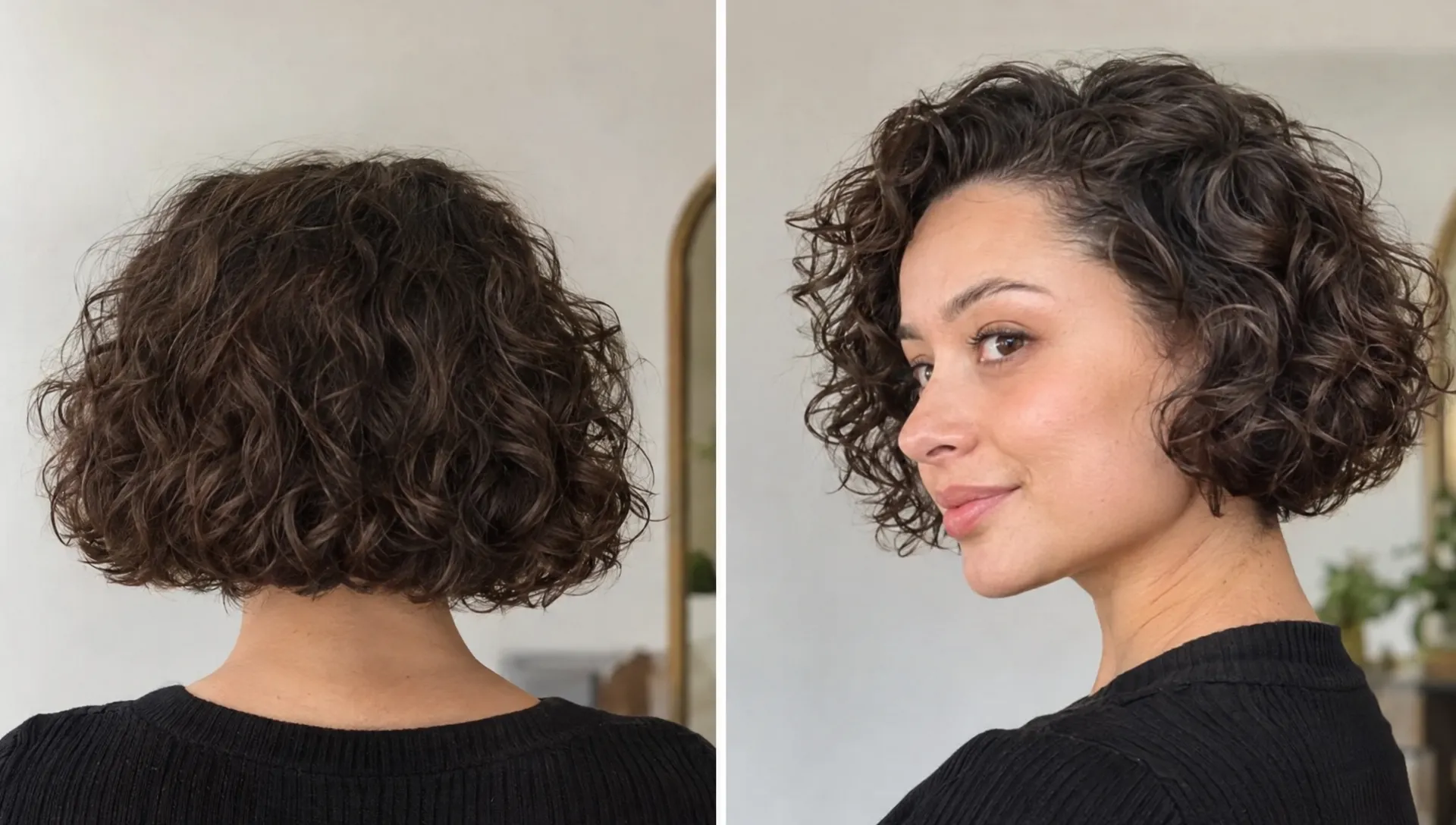
A short curly bob has a flat crown and wide lower edge in one view, and a rounded outline with lifted roots and defined curls in the other.

Finish without fluffing every section equally

Wait until your hair is fully dry before separating curls or softening a gel cast. Manipulating damp curls can disrupt their grouping and make the outline less predictable.

If you want more height, loosen the roots gently with your fingertips rather than raking through the entire length. Leave the sides mostly undisturbed if they already have enough fullness.

Check the back with a second mirror. It is easy to keep adding volume at the front while missing a flat crown or a dense lower-back section.

What to do if your bob already looks triangular

Start with the least permanent adjustment. Reset your curls with a normal wash, apply products deliberately and let the hair dry completely before judging the cut. Hair compressed by sleep, a hat or a tight tuck behind the ears may not show its usual shape.

If the imbalance remains, book a shape consultation rather than requesting an all-over trim. Cutting the same amount from every section may shorten the bob without changing where its fullness sits.

For an existing short curly bob, the most useful correction may be small: adjusting a few heavy sections, refining the face frame or preserving the perimeter while upper layers grow. It does not always require a dramatic restyle.

If the ends are already sparse, further thinning is unlikely to create the fuller, rounder result you want. Ask what can be improved now and what needs time to grow. Avoid cutting a curl at home simply because it sticks out on one wash day; its position can change with moisture, styling and shrinkage.

Keep the shape balanced as it grows

A bob can lose its balance before it looks noticeably longer. Upper layers may begin to weigh down the crown while the lower edge gathers more fullness.

Instead of choosing a maintenance interval based only on the calendar, watch for changes in styling effort. Needing much more root lifting, repeatedly pinning back the sides or losing the intended outline can signal that it is time for a shape review. Your stylist can recommend timing based on the cut and your growth pattern.

Take a few photos after a wash day you like. Those images give you and your stylist a useful reference for how the haircut behaves at home, not just immediately after a salon finish.

Keeping a short curly bob balanced is easier when maintenance follows its changing shape. For more on that process, see how a curly hair stylist creates a cut that grows out well.

Frequently asked questions

Does every curly bob need layers? No. Lower-density hair or looser curls may suit a stronger perimeter with minimal layering. Layers are useful when they solve a specific weight or shape issue, not simply because the hair is curly.

Can I keep a blunt edge without getting a triangle shape? Sometimes. A defined outer edge can coexist with selective shaping inside the haircut. Whether that works depends on your density, curl behavior and preferred amount of width around the jaw.

Will cutting the bob shorter fix the problem? Not automatically. Shortening can release more curl spring and increase width in some sections. The placement of weight needs to change if excess lower fullness is the underlying issue.

Can I fix the shape without heat styling? If flattened roots are the main problem, careful product placement and supported air-drying may help. If the silhouette comes from the cut, styling alone will have limits.

Plan your shape before your next trim

Bring photos of your hair on both a good wash day and a difficult one, then describe where you want more or less fullness. That gives your stylist a clearer starting point than asking for fewer layers or less bulk.

For a personalized haircut consultation in Warner Robins, GA, book an appointment with Kingdom Cute. Discuss your natural texture, daily routine and preferred silhouette before deciding how much hair to remove.

What Defines a Truly Luxury Limousine Service?

What Defines a Truly Luxury Limousine Service?

A luxury limousine service should make travel feel effortless, not simply make the vehicle look impressive. The difference lies in what happens around the ride: how accurately the booking is planned, how professionally the chauffeur handles the journey and how clearly the company responds when circumstances change.

Leather seating and a polished exterior matter, but they cannot compensate for an unclear airport pickup, insufficient luggage space or unexpected charges. True luxury combines physical comfort with dependable service and fewer decisions for the passenger.

That standard applies whether you are arranging an executive airport transfer, wedding transportation or an evening with friends. The vehicle should suit the occasion, while the service should protect your time and respect your preferences. To judge the experience fairly, look beyond the fleet photographs and examine who takes responsibility for each part of the journey.

What a luxury limousine service should take responsibility for

A strong booking process turns a travel request into an agreed plan. It should establish more than a date, an address and a passenger count.

Consider a seemingly simple airport transfer for four travelers. The right arrangement depends on luggage volume, terminal access, arrival procedures and whether everyone is traveling on the same flight. A company that identifies those details before confirming the reservation reduces the chance of an uncomfortable surprise.

Part of the journey What should be clear before booking
Service scope One-way transfer, hourly reservation or multi-stop itinerary
Vehicle suitability Seating, luggage capacity and any essential access requirements
Pickup arrangements Meeting location, contact procedure and applicable waiting policy
Changes and charges How revisions, additional time and cancellations are handled

The useful distinction is between a promise and an arrangement. “We will take care of everything” sounds reassuring, but a written confirmation explaining the pickup process is more valuable. Not every detail needs a lengthy discussion; the company should identify the details that could affect your particular trip.

The right vehicle fits the journey, not just the photograph

A luxury limousine service selects transportation around the passengers and their plans. The longest vehicle or most elaborate interior is not automatically the best choice.

For an airport journey, a luxury SUV may be more practical than a stretch limousine when several passengers have large suitcases. For a wedding, comfortable entry and exit can matter as much as the appearance of the vehicle. For an executive transfer, a quiet cabin may be more useful than entertainment equipment.

Passenger capacity and luggage capacity are separate questions. A vehicle advertised for a certain number of people may not accommodate that group comfortably with checked bags, garment bags or event supplies. Ask about both before choosing a vehicle class.

Comfort also depends on working climate control, clean upholstery, unobstructed seating and a well-maintained cabin. If a particular amenity matters, confirm it for the reserved vehicle rather than assuming that every vehicle in the fleet offers it. The same applies to an exact model: clarify whether the reservation guarantees that model or a comparable vehicle class.

Chauffeur professionalism is practical, not performative

The chauffeur is where much of the service becomes visible. A professional appearance is appropriate, but judgment, preparation and considerate driving matter more throughout the ride.

With a luxury limousine service, passengers should not need to manage the driver. The chauffeur should understand the confirmed itinerary, know the pickup procedure and communicate clearly when coordination is necessary. Courtesy includes offering assistance without being intrusive and recognizing when passengers prefer silence.

Discretion matters during business conversations and private celebrations alike. Passengers should be able to set the tone of the cabin without feeling obliged to entertain the chauffeur or explain why they want a quiet journey.

Safety belongs in this assessment too. Ask whether the operator holds the licenses, operating authority and commercial insurance appropriate to the service and jurisdiction. For applicable interstate transportation, the Federal Motor Carrier Safety Administration’s passenger-safety resources provide a useful starting point for understanding carrier oversight. Requirements vary by vehicle and operation, so a federal registration number alone is not a universal test of legitimacy.

A smooth ride should never depend on speeding, abrupt maneuvers or pressure to recover an unrealistic schedule.

Reliable timing starts before the pickup

Punctuality is partly a scheduling decision. A carefully driven vehicle can still arrive late if the booking leaves no realistic allowance for traffic, terminal procedures or venue access.

A luxury limousine service should help translate your required arrival time into a workable pickup time. For a wedding, that means considering when the party must be ready for photographs or the ceremony, not merely when the event officially begins. For business travel, the relevant deadline might be building check-in rather than the meeting itself.

Airport transfers require another distinction: landing time is not passenger-ready time. Travelers may need to clear immigration, collect luggage and reach an approved meeting point. Flight tracking helps identify schedule changes, but it does not replace clear instructions about where to meet or when waiting charges begin.

Grand Limousine’s guide to what to expect from a professional limousine airport service explores the airport experience in more detail. Before confirming any airport booking, establish whether pickup is curbside or a meet-and-greet arrangement, along with the applicable waiting terms.

The response to disruption reveals the service standard

A delayed flight, a closed venue entrance or a meeting that runs late can test an otherwise straightforward reservation. The strongest service is not one that promises disruptions will never happen. It is one that makes the next step clear.

A luxury limousine service should give you an accessible contact and explain how changes are handled. That includes who to notify, whether the revised itinerary can be accommodated and what additional costs may apply. Availability around the clock is useful only if you understand how to reach the appropriate support.

Ask how the company would communicate a vehicle substitution or a significant delay. You are looking for an understandable process, not an unrealistic guarantee that the original plan can always remain unchanged.

There is also a limit to what any transportation provider can control. Airport restrictions, road closures and severe weather may affect the journey. Professional handling means communicating the constraint promptly, explaining available options and avoiding promises that conflict with safe operation.

A chauffeur helps adult travelers place suitcases into a luxury SUV at the airport, coordinating their arrival for a limousine transfer.

Transparent pricing makes comfort easier to enjoy

A premium experience should not leave you calculating unknown charges from the back seat. The quoted amount should be understandable in relation to the itinerary you have provided.

Depending on the reservation, pricing may involve a transfer rate, an hourly minimum or a longer event booking. Ask whether the total includes tolls, parking, airport fees, waiting time and gratuity. Not every charge must be included in one flat amount, but anything excluded should be explained clearly.

When comparing a luxury limousine service with another option, compare the same scope. A one-way ride is not equivalent to a vehicle reserved for several hours with intermediate stops. Likewise, a lower initial quote may not be the lower final price if it excludes charges included elsewhere.

Written terms should also address overtime, additional stops, cancellations and changes to the reservation. For weddings or corporate events, clarify who is authorized to approve extra time. That small decision can prevent passengers, assistants and event planners from giving conflicting instructions.

Transparent pricing does not mean the lowest price. It means understanding what you are buying and what could change the total.

Personalization should solve a real travel need

Thoughtful service responds to the purpose of the journey rather than adding extras indiscriminately. The most useful request may be a quiet cabin, room for formal clothing or a carefully coordinated departure sequence.

For corporate transportation, consistency may matter most: accurate pickup details, discreet service and a plan that works across several travelers. For a wedding, the priority may be keeping the couple’s departure separate from guest transportation. For a group outing, confirming stops and a final return time can do more for the evening than an elaborate amenities list.

A luxury limousine service should distinguish between preferences and requirements. A preferred cabin temperature is different from an accessibility need that determines whether a vehicle is suitable at all. Discuss mobility equipment, child-restraint needs or other essential arrangements before booking, and request explicit confirmation rather than assuming availability.

Personalization works best when the details are captured in the reservation. A request mentioned casually but never confirmed is not a dependable arrangement.

Frequently asked questions

How much does a limousine cost for a full day? There is no universal daily rate. Vehicle type, location, date, service duration, mileage and itinerary all affect the quote. Define what “full day” means in hours and ask about included mileage, overtime, parking and gratuity. A written quote for your actual schedule is more useful than a generic daily estimate.

How much should you tip a limo chauffeur for a one-hour ride? Check the invoice first to see whether gratuity is included and distinguish it from any service charge. If it is not included, 15% to 20% of the base fare is a common tipping range in the U.S., adjusted at your discretion for the service received. Confirm how the company calculates any suggested gratuity.

Is a limousine cheaper than Uber? It depends on the trip. A rideshare may cost less for a short, simple journey. Reserved group transportation may compare more favorably when several people travel together or need multiple stops. Compare total trip costs, vehicle capacity, waiting arrangements and service scope rather than assuming either option is always cheaper.

Does luxury transportation always mean a stretch limousine? No. A luxury limousine service may use an executive sedan, SUV, stretch limousine or another suitable chauffeured vehicle. The defining qualities are comfort, professional service and a well-managed journey, not vehicle length alone. Choose the vehicle that accommodates your passengers, luggage and occasion.

Plan your ride around the details that matter

Grand Limousine offers nationwide transportation with professional chauffeurs, a diverse luxury fleet, 24/7 service and dispatch, plus airport transfers with flight tracking. When requesting a quote, share your passenger count, luggage needs, itinerary and any essential arrangements.

Explore Grand Limousine’s transportation options and confirm the vehicle, pickup procedure and complete pricing for your trip before booking.

Friday, October 16, 2026

What a Blowout on Short Natural Hair Can Realistically Achieve

What a Blowout on Short Natural Hair Can Realistically Achieve

A blowout on short natural hair can reveal length hidden by shrinkage, soften the silhouette of a cut and make shaping easier. It cannot create extra inches, change your natural density or guarantee a glass-smooth finish without additional styling. The most satisfying result starts with choosing a look your current length and hair condition can support, rather than expecting a short, tightly coiled cut to behave like a shoulder-length silk press.

Start with stretch, not a longer haircut

A traditional blowout uses a blow-dryer and controlled tension to temporarily stretch and shape the hair. On natural curls and coils, the change may be noticeable because the strands no longer sit as tightly contracted.

That is existing length becoming more visible, not new length. Hair that looks cropped when coiled may form a fuller rounded shape when stretched. A tapered cut may show more height through the top while staying close at the sides.

The finish can still have texture. Soft volume, movement and some remaining curl are all valid outcomes. Completely straight roots and highly polished ends are different goals that may call for another technique.

A standard blowout is also different from a Brazilian Blowout or other chemical smoothing service. A silk press generally adds flat-ironing after blow-drying. Ask what the appointment includes so you can make an informed choice about both the finish and the heat involved.

What a blowout on short natural hair can realistically look like

“Short” covers several very different starting points. The length available in each section matters more than a single label such as pixie or cropped cut.

Starting shape A realistic possibility What may limit the result
Very close crop A softer surface or modest directional shaping There may not be enough length to engage a brush safely
Tapered cut with a longer top More visible height, a lifted front or a rounded top Short sides will not suddenly gain the movement of longer sections
Ear-length curls or coils An expanded silhouette, a side sweep or softly turned ends Layers and shrinkage affect where the finished outline sits
Short bob-length natural hair More visible length, a smoother outline and some swing Density, strand condition and the cut influence movement

These are possibilities, not promises. One person's ear-length cut may have enough stretched length to tuck behind the ear, while another person's will not.

A good result should also look intentional from the side and back. If the haircut has uneven lengths, stretching can make those differences more visible rather than hide them.

Why similar lengths can produce different results

The outcome of a blowout on short natural hair depends on more than curl pattern. Two people with similar-looking coils can leave with very different amounts of volume and movement.

Density describes how much hair grows across the scalp; strand thickness describes the size of individual hairs. Dense hair may create a fuller silhouette, while lower-density hair may show more scalp around a strong part. Fine strands can become weighed down by products even when the overall head of hair is dense.

Shrinkage changes the before-and-after contrast, too. Greater shrinkage can make stretching look dramatic, but it does not tell you how healthy or heat-tolerant the hair is.

Condition matters just as much. Fragile ends, previous lightening or frequent heat use may make a gentler, less stretched finish the better choice. Stronger tension is not automatically the answer to hair that resists smoothing.

If you are comparing several finishes, understanding how to choose a blowout for your hair type can help you separate a volume goal from a straightness goal before your appointment.

Choose a reference photo for its shape, not just its shine

A useful reference for a blowout on short natural hair shows a comparable starting length and cut. A glossy photograph alone tells you little about whether the look required a flat iron, rollers, added hair or extensive finishing.

Look at where the volume sits. Is the top lifted while the sides stay compact? Do the ends curve under? Is the front long enough to sweep across the forehead? Those details give your stylist something concrete to assess.

Bring a photo of your own hair in a previous stretched style if you have one. It can be more useful than a stranger's finished look, especially when deciding how much length will be available around the face.

You can describe your goal this way: “I want the top stretched enough to sweep sideways, but I am comfortable keeping some texture. I do not want extra flat-ironing just to match the photo.”

Also identify what you do not want, such as a very expanded outline, flattened roots or ends turned tightly under. “Smooth” and “full” mean different things to different people.

Set a heat boundary before styling begins

A blowout on short natural hair is still heat styling. Short strands do not become damage-proof, and working close to the roots requires care around the scalp.

The American Academy of Dermatology's guidance on preventing hair damage recommends using the lowest heat setting and reducing how often heat tools are used. A heat protectant is a useful precaution, but it does not make unlimited heat or repeated passes safe.

Tell your stylist about recent coloring, breakage, scalp tenderness and how often you use heat at home. Ask whether your preferred finish is achievable with blow-drying alone. If extra smoothing would require flat-ironing, that should be a separate decision rather than an unexpected finishing step.

Comfort is a boundary, not a test of endurance. Speak up if the air feels painfully hot or the brush pulls at your scalp. More pulling should not be treated as the price of a smoother result.

When the hair cannot safely support the reference look, preserving some texture is a better outcome than repeatedly chasing the last bit of curl.

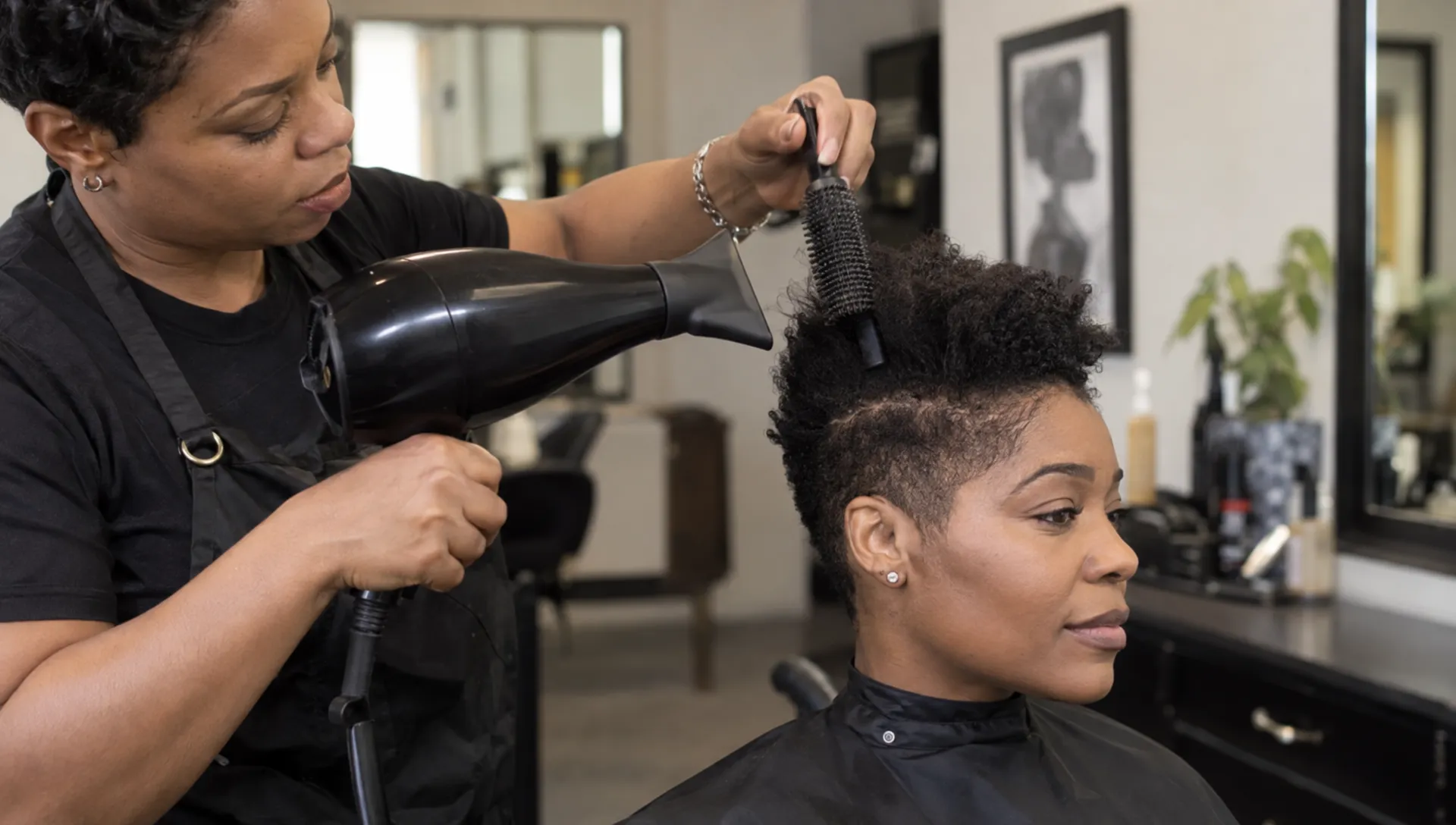
A stylist uses a concentrator nozzle and small styling brush on short natural hair, stretching the tapered top while keeping the sides close.

Expect a temporary style, not a weatherproof finish

There is no reliable wear-time promise for every head of hair. Humidity, sweat, washing, sleep habits and the amount of stretching all affect how quickly the shape changes.

A blowout on short natural hair may also evolve unevenly. The hairline can regain texture before the crown, while shorter sections may flatten overnight instead of holding the same curve as longer sections. Neither change automatically means the original styling was poorly done.

At night, a satin bonnet or scarf can reduce friction, but the fit matters. A tight wrap may flatten the height you wanted to preserve. Very short sides may need little manipulation, while a longer top may benefit from a loose arrangement your stylist demonstrates.

For more detailed maintenance, use these tips on making a blowout last longer without repeated heat styling. The goal is to preserve a wearable shape, not to force every section to remain identical to appointment day.

Agree on the finish before the dryer comes out

A consultation should establish a primary goal: visible length, root lift, a smoother outline or preparation for another style. Trying to maximize all four can lead to unnecessary styling and disappointment.

Ask your stylist to assess the shortest sections as well as the top. Those areas often determine whether a side sweep, rounded shape or tucked finish is realistic.

It is also worth discussing the haircut itself. A blowout can reveal an outline, but it cannot repair split ends or permanently correct an uneven cut. If reshaping would help, ask about that separately rather than assuming it is included.

Before leaving, have your stylist show you one simple way to reset the front or crown without adding heat. A finish you can comfortably wear and maintain is more useful than one that only looks right immediately after styling.

Frequently asked questions

How short is too short for a blowout? There is no universal minimum. A blowout on short natural hair requires enough length for the chosen tool and technique to work without excessive pulling. Very close-cropped sections may be better suited to gentle shaping than a brush-stretched finish.

Will my curls return after washing? A standard blowout is intended to be temporary, so the natural pattern should return when the hair is washed. Heat damage can prevent full reversion, however. Persistent straight sections, unusual breakage or a lasting texture change deserve assessment before more heat styling.

Can I refresh the style in two minutes? Sometimes. Adjusting the part, gently lifting flattened roots with your fingers or smoothing the front into a new direction may be enough. If the hair has substantially reverted, a two-minute refresh will not recreate the original finish without more involved styling.

Does a blowout make short hair healthier? No. It changes the appearance and arrangement of the strands. A polished finish is not proof of improved hair health, and heat styling does not repair damaged ends.

Plan a finish that works with your cut

The best blowout on short natural hair makes the most of the length you have without asking your strands to tolerate more than they should. A soft, shaped finish can be a successful result even when it is not completely straight.

At Kingdom Cute in Warner Robins, GA, discuss your reference photos, hair history and styling priorities during a personalized consultation. Use online appointment booking to plan a visit and choose a finish that suits your cut and everyday routine.

How Much Should You Tip a Limo Driver?

How Much Should You Tip a Limo Driver?

When deciding how much to tip a limo driver, use 15% to 20% of the transportation fare as a practical U.S. guideline, provided gratuity is not already included. For a $300 fare, that means $45 to $60 for the chauffeur. A larger tip is optional for exceptional service, not an automatic requirement.

Before reaching for cash or approving another card charge, check your reservation. Limousine service invoices may list gratuity, service charges and other fees separately, and those labels do not always mean the same thing.

How much should you tip a limo driver?

For a professionally handled ride, 15% to 20% is a customary tipping range, with 20% being a straightforward choice when you are happy with the service. This is an etiquette guideline, not a universal requirement.

Consider the complete experience: safe driving, a clean vehicle, courteous communication, punctual arrival and appropriate help with luggage. Special assistance or excellent coordination during a complicated itinerary may justify more, but you do not need to exceed your budget.

These examples show the math, not Grand Limousine rental prices:

Transportation fare before gratuity 15% tip 18% tip 20% tip
$150 $22.50 $27 $30
$300 $45 $54 $60
$600 $90 $108 $120
$1,000 $150 $180 $200

The percentage generally applies to the vehicle’s fare, not separately to every passenger. If several people share a ride, divide one agreed gratuity among the group rather than having everyone calculate a full percentage of the booking.

Check whether gratuity is already included

The most expensive tipping mistake is paying twice because you overlooked a line on the confirmation. Check the final invoice as well as the original quote, particularly if the itinerary changed.

A clearly listed chauffeur gratuity

If your reservation includes a line such as “chauffeur gratuity: 20%,” you generally do not need to add another tip. Additional cash is a personal thank-you for service you felt deserved extra recognition.

Check whether that gratuity covers the entire reservation. An added return trip, extended rental or additional vehicle may be billed separately and could have its own tipping arrangement.

A service charge or administrative fee

Do not assume a service charge is the driver’s tip. A company may use that label for a fee that serves another purpose or includes several components.

The IRS distinguishes voluntary tips from mandatory service charges for tax purposes. For your booking, the practical question is whether the quoted charge covers the chauffeur’s gratuity.

Ask the reservation team: “Does this fee include the chauffeur’s gratuity, or should I budget for that separately?” Request confirmation before the ride rather than trying to interpret the invoice at drop-off.

A prepaid or company-arranged reservation

A paid-in-full booking does not necessarily mean the driver’s tip has been paid. Likewise, “all-inclusive” should be clarified rather than treated as proof that gratuity is covered.

If an employer, wedding planner or travel coordinator booked the vehicle, ask that person to check the reservation. This avoids both duplicate tipping and an awkward conversation with a chauffeur who may not control billing.

Calculate the tip on the transportation fare

A straightforward approach is to calculate gratuity on the transportation fare before taxes, tolls, parking and other pass-through charges. Do not calculate an additional percentage on gratuity already listed on the bill.

For example, suppose an illustrative invoice contains a $400 transportation fare and $40 in combined taxes and tolls. A 20% tip on the fare is $80, bringing the total to $520 if no gratuity has already been added.

For an hourly rental, use the fare for the full service period, including applicable overtime, rather than applying the percentage to just one hour. A deposit is also not the right starting point: it is only a partial payment toward the reservation.

If you need help separating rental charges from extras, Grand Limousine’s explanation of how limo pricing works provides useful context. Keep the tipping calculation separate from the question of whether the original fare fits your budget.

Tipping for airport transfers, weddings and group rides

The same basic percentage can work across different trips. What changes is who pays, when the tip is handed over and whether more than one chauffeur is involved.

Airport transfers and black car service

For a private airport transfer, 15% to 20% of the fare is a practical starting point when gratuity is not included. Helpful luggage handling, clear pickup instructions and patient assistance can inform where you land within that range.

You do not need to add a separate per-bag tip on top of a chauffeur gratuity unless you want to. If different drivers handle your outbound and return journeys, check gratuity for each leg and tip each driver separately when appropriate.

Wedding transportation

For wedding transportation, check the contract before setting aside tip envelopes. A package may already include gratuity, and multiple vehicles may have separate billing arrangements.

Assign one trusted person, such as a planner or family member, to handle any outstanding tips. Label envelopes by vehicle, chauffeur or trip assignment so they reach the right person. If several drivers provide service, ask the transportation company how the fare and any prepaid gratuity are allocated rather than assuming one driver distributes everything.

Party buses and shared celebrations

A party bus tip is normally calculated for the reservation as a whole, not as a separate percentage owed by every guest.

For example, a $1,200 transportation fare with a 20% gratuity produces one $240 tip. Split among 12 paying passengers, that is $20 each. Agree on the contribution before the event and have one organizer make the payment.

Cleaning, damage or overtime charges are separate billing matters. Do not assume those payments replace the driver’s gratuity.

Corporate transportation

For corporate transportation, check the account arrangement and your employer’s expense policy. Gratuity may already be handled through centralized billing.

If you are responsible for adding it, use an approved payment method and keep the receipt. A business traveler should not feel obliged to pay twice simply because the company’s billing details are not visible in the vehicle.

At an airport curb, a traveler holds a small envelope beside a luxury sedan after the chauffeur has unloaded the luggage.

When and how should you give the tip?

The end of the service is usually the simplest time to tip, after you have arrived and the chauffeur has helped unload your belongings. For a multi-stop booking with the same driver, you can generally wait until the final drop-off rather than tipping at every stop.

Cash is convenient when handed directly to the chauffeur. An envelope can be helpful for weddings or other events where someone else is handling payment, but it is not necessary for an ordinary airport ride.

If you prefer to use a card, ask the company beforehand whether gratuity can be added to the reservation or final payment. Payment options differ, so do not assume the driver can process an additional charge at the curb.

A brief “Thank you for taking care of us today” is enough. There is no need to announce the amount in front of other passengers.

Should you adjust the tip for poor service or delays?

An optional tip can reflect the service you received. Discourteous behavior, avoidable communication failures or an unclean vehicle may reasonably affect your decision.

Distinguish those issues from circumstances outside the chauffeur’s control. Traffic, airport restrictions and delayed flights do not automatically indicate poor service. Consider how the driver communicated and managed the disruption rather than judging only the arrival time.

For unsafe driving, impairment or a serious service failure, prioritize safety and contact the transportation company. A tipping discussion is not a substitute for reporting the problem.

If gratuity or a service charge was already billed, raise a complaint with the company instead of assuming you can deduct it from the agreed payment.

Frequently asked questions

Is $20 a good tip for a limo driver? It depends on the fare. A $20 tip equals 20% of a $100 fare but only 5% of a $400 fare. Use the transportation charge and any included gratuity to judge the amount rather than relying on a fixed dollar figure.

Should you tip extra if 20% gratuity is included? No additional tip is generally expected. You can give more for exceptional service, but an included 20% gratuity usually takes care of the customary amount.

Do you need to tip more on a holiday? A holiday does not create a separate tipping requirement. You may choose to give extra as a thank-you, but first check whether gratuity is included and distinguish any holiday surcharge from the driver’s tip.

Do these tipping guidelines apply outside the United States? Not necessarily. Chauffeur tipping customs vary by country, and some destinations include service in the fare or have different expectations. Check local practice and the booking terms rather than automatically applying U.S. percentages.

Confirm the details before your next ride

Budgeting for a chauffeur tip is simple once you know the fare and what is already included. Start with 15% to 20%, confirm any gratuity line and arrange one clear payment at the end of the service.

When booking with Grand Limousine, request a clear quote and ask how gratuity is handled for your specific reservation. That leaves you free to focus on the airport pickup, celebration or business itinerary rather than last-minute payment questions.